ThorOS Review
ThorOS 1.5.5: The Debian-Based GNOME Distro You Can Talk To
Most distributions compete on desktops, installers or how little bloat they ship. ThorOS competes on how you control the machine. According to its DistroWatch listing, ThorOS is a Debian-based desktop Linux distribution featuring the GNOME desktop, and its principal feature is “voice control” — an artificial intelligence assistant called “Jarvis” that can execute commands to accomplish a great variety of tasks.
The newest release in DistroWatch’s feature table is ThorOS 1.5.5, released on 12 August 2026. It is free, listed as Active, and categorised by DistroWatch as Desktop, Large Language Model and Live Medium — that middle category alone tells you this is not a conventional respin. DistroWatch lists its origin as the USA, its architecture as x86_64 only, and its base as Debian (Stable). It sits at number 407 in DistroWatch’s popularity rankings with 32 hits per day, and visitors rate it a perfect 10.0 out of 10 — albeit from just 1 review, so treat that score as enthusiasm from a very small sample rather than a consensus.
That stable foundation will be familiar to anyone who has read our Debian review — ThorOS takes Debian Stable as its starting point, then adds something Debian itself does not attempt: a desktop you are meant to talk to.
At a Glance
| Latest Release | ThorOS 1.5.5 (12 August 2026) |
| OS Type | Linux |
| Base | Debian (Stable) |
| Origin | USA |
| Desktop | GNOME |
| Architectures | x86_64 |
| Installer | Graphical installation, per DistroWatch’s feature table |
| Package Management | apt — deb package format |
| Release Model | Fixed |
| Init System | systemd |
| File Systems | Btrfs, ext4, JFS, XFS (journaled) |
| Default Browser | Firefox ESR |
| Office Suite | LibreOffice |
| Category | Desktop, Large Language Model, Live Medium |
| Price | Free (ISO image size 6,400–6,500 MB; free ISO download) |
| DistroWatch Popularity | 407 (32 hits per day) |
| Visitor Rating | 10.0/10 from 1 review |
Meet Jarvis: Voice Control as the Main Event
DistroWatch’s description is specific about what Jarvis can do, and the examples give a clear picture of the ambition. You can say “Jarvis, open Firefox”, “Jarvis, write a thank-you note to my landlord”, or “Jarvis, what’s 15% of 240”. Beyond those examples, DistroWatch says Jarvis is also able to create, open, read, write, move, rename, search and delete files, launch applications, answer general questions, remind the user about appointments, and run terminal commands.
Refinance Your Student Loan At Sofi
That is a much wider brief than a simple voice launcher. File management, reminders, questions and terminal commands cover a large share of what many people actually do at a desktop each day, which is presumably the point: ThorOS is testing whether voice can be a primary interface rather than an accessibility extra or a novelty. Whether it suits you will depend on your workspace — talking to your computer is easier in a home office than in a shared room — but as a defining idea, it clearly separates ThorOS from other Debian-and-GNOME systems such as Synex’s frugal Debian take, which competes by leaving things out rather than by adding a new way to interact.
Private by Default, With a Choice About Knowledge
The privacy line in DistroWatch’s description deserves attention, because an always-available assistant raises an obvious question. DistroWatch states that the distribution’s artificial intelligence assistant is private by default, but can be configured to use a remote source of knowledge, if desired.
That order matters: local and private is the starting position, and reaching out to a remote source is the user’s configuration choice, not the default behaviour described by DistroWatch. For readers weighing an AI-centred desktop, that distinction is the first thing to verify on a live system — try ThorOS first in its live-medium form, check the assistant’s settings before installing, and only enable a remote source if you understand and accept what it changes.
Try YouTube TV | Special Discount
A Conventional, Solid Debian Foundation Underneath
Strip away Jarvis and the underlying system is deliberately ordinary, which is a sensible pairing for an experimental interface. The feature table for 1.5.5 lists a fixed release model, systemd, Firefox ESR as the default browser and LibreOffice as the office suite. Packages are in deb format and managed with apt, exactly as Debian users would expect, and the listed journaled file systems are Btrfs, ext4, JFS and XFS. Installation is graphical, the system is listed as multilingual in English (en), and the ISO is a large 6,400–6,500 MB download.
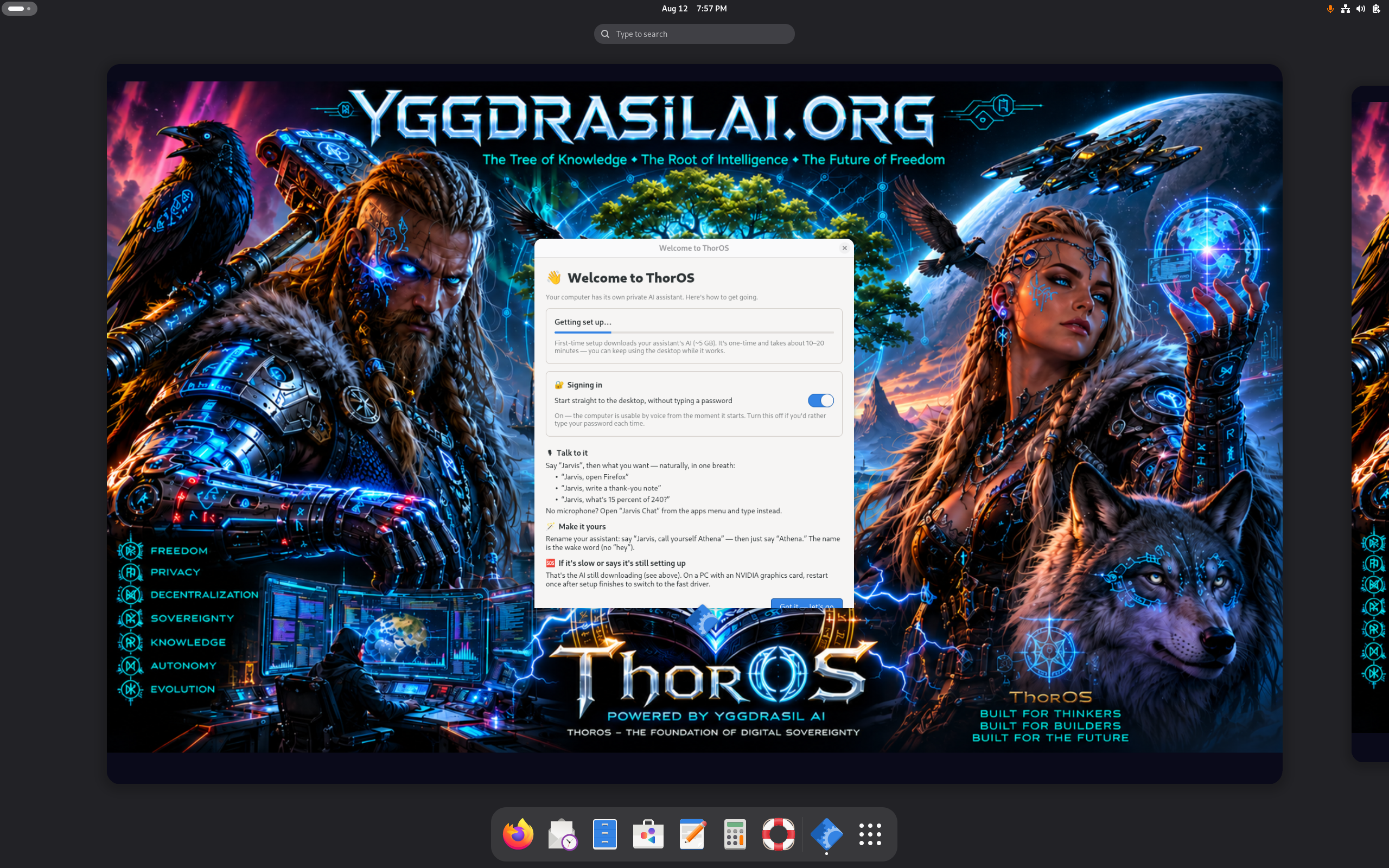
The desktop is GNOME, presented in the project’s own screenshot as a clean, dock-style layout. If you want to compare a GNOME system built by the GNOME project itself, see our GNOME OS review — ThorOS instead layers its assistant on top of a Debian Stable base, trading GNOME OS’s upstream purity for Debian’s fixed-release stability.
Who Should Try ThorOS?
- Users curious about voice-first computing — Jarvis handles files, applications, questions, reminders and terminal commands by voice, per DistroWatch; no other distro in this library makes voice control its principal feature.
- Debian users who want something genuinely different — you keep Debian Stable, apt and deb packages, systemd and GNOME, while the experiment happens in how you interact with them.
- Privacy-conscious users willing to check the settings — DistroWatch says the assistant is private by default and only uses a remote knowledge source if you configure it to.
- People with accessibility or hands-busy workflows in mind — opening applications, managing files and asking questions by voice could suit anyone who cannot always work at a keyboard, though you should test it live against your own needs first.
- Anyone who prefers a calmer Debian alternative as a fallback — if voice control is not for you, our MX Linux review covers a popular Debian-based option that sticks to conventional controls.
Final Thoughts
ThorOS is one of the more distinctive ideas in this part of the library: a free, x86_64-only Debian Stable system with GNOME, Firefox ESR, LibreOffice, apt and a fixed release model — all of it conventional — carrying one unconventional bet, that you will want to talk to your desktop and let Jarvis act on what you say. Its DistroWatch numbers show how early that bet still is: rank 407 with 32 hits per day is near the bottom of the popularity table, and the 10.0/10 visitor rating rests on a single review.
That makes ThorOS a try-live-first recommendation. Boot the roughly 6.5 GB ISO as a live medium, test Jarvis on the tasks DistroWatch lists — opening applications, moving files, answering questions, running a terminal command — and confirm the private-by-default setup matches your expectations. If voice control clicks for you, there is very little else like it on a Debian base. If it does not, you have still only spent a download finding out.
Source: DistroWatch’s ThorOS listing, covering the ThorOS 1.5.5 release of 12 August 2026.