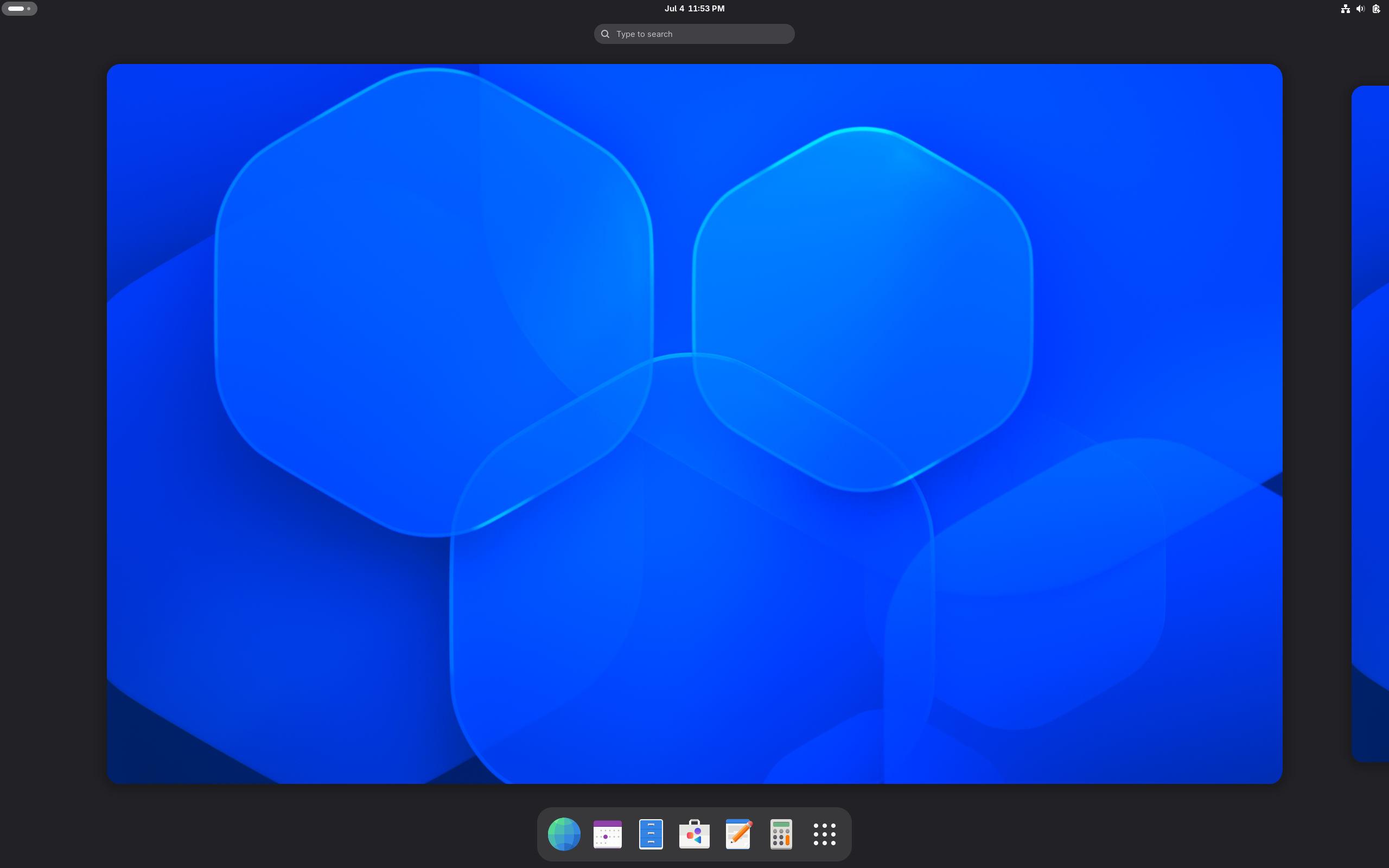
GNOME OS Review
GNOME OS 20260703.2: An Immutable Preview of GNOME’s Cutting Edge
GNOME OS is not trying to be your next daily driver — and its DistroWatch listing is upfront about that. It describes GNOME OS as an experimental, immutable Linux distribution that ships the latest in-development GNOME desktop, core applications and stack, serving as a reference for developers and testers. It is independently based, ships the GNOME desktop on x86_64 hardware, and the listing was last updated on October 6, 2026, showing the build gnomeos-20260703.2-gnome.
Immutability is the whole point of this distribution. The listing notes that GNOME OS initially used OSTree to deploy the root filesystem and manage updates, but later migrated to systemd-sysupdate, which brings enhanced immutability, auto-updating, adaptability, factory reset, uniformity and modernised security properties. If you want an immutable desktop built for everyday use rather than a reference image, our Vanilla OS review covers a GNOME-flavored option in that camp.
The numbers are modest, as you would expect for a developer reference image: DistroWatch ranks GNOME OS at popularity 56 with about 205 hits per day, and its average visitor rating is 9.0 out of 10 across two reviews.
Source: DistroWatch GNOME OS comparison table
GNOME OS at a Glance
| Feature | GNOME OS |
|---|---|
| Build shown | gnomeos-20260703.2-gnome (listing updated 2026-10-06 UTC) |
| Release model | Not listed (dated build images) |
| Cost | Free download |
| Based on | Independent |
| Origin | Global |
| Default desktop | GNOME (GNOME Shell 51.0 in the package list) |
| System core | systemd-based userland built from the Freedesktop SDK |
| Update mechanism | systemd-sysupdate (previously OSTree) |
| Package management | No traditional package manager; Flatpak supported out of the box |
| Installation method | Live image (loadable in Boxes, VirtualBox, QEMU); installable on standard x86_64 hardware |
| Supported architecture | x86_64 |
| Init system | Not listed (the listing describes a systemd-based userland) |
| Category | Desktop, Immutable, Live Medium |
| Status | Active |
| DistroWatch popularity rank | 56 (205 hits per day) |
| DistroWatch visitor rating | 9.0/10 from 2 reviews |
| Home page | https://os.gnome.org/ |
Table note: The surrounding scrolling container is intentional. It prevents a wide table from breaking a mobile layout and lets visitors scroll horizontally when necessary.
A Reference OS, Not a Daily Driver
The single most important thing to understand about GNOME OS is its audience. The DistroWatch description frames it as a reference for developers and testers — the place where the GNOME project’s own in-development desktop, core applications and stack can be seen running as a complete system. It is the GNOME equivalent of a concept car: built to show what is coming, not to carry your groceries.
That reference status puts it in interesting company. The listing’s review links point to external write-ups including DistroWatch’s own 2025 review, plus reviews from TechBloat, blog.while-true-do.io and It’s FOSS — enough third-party attention for a project that was never meant for mainstream adoption. And GNOME is not alone in shipping a project-owned OS: our KDE Linux review looks at the KDE project’s answer to the same idea, a showcase for the latest Plasma work.
Immutable by Design: From OSTree to systemd-sysupdate
The immutability story is where GNOME OS gets genuinely interesting for distribution watchers. According to the DistroWatch listing, the project started with OSTree to deploy the root filesystem and manage updates — the same image-based update technology behind Fedora Silverblue and similar systems — and then migrated to systemd-sysupdate. The listing credits the move with enhanced immutability, auto-updating, adaptability, factory reset, uniformity and modernised security properties.
Underneath, the system is described as a modern systemd and GNU-based userland built from the Freedesktop SDK, with systemd 262 in the tracked package list. This is a distribution engineered as a showcase for where the Linux platform is heading: image-based, atomically updated, resettable to a known-good state. For a distribution built around immutability as a philosophy, the systemd-sysupdate migration is the headline feature — it is GNOME OS participating in, and stress-testing, one of the biggest architectural shifts in desktop Linux.
Flatpak First: No Package Manager, No Problem
GNOME OS does not support traditional package management at all — there is no apt, no dnf, no pacman here, and the listing is explicit about it. Instead, additional software is installed through Flatpak, which is supported out of the box (version 1.19.1 in the current package list). The base system ships the latest in-development GNOME desktop — GNOME Shell 51.0 at the time of the listing — and everything on top of that comes as a sandboxed Flatpak.
Refinance Your Student Loan At Sofi
Trying it is deliberately low-friction: the distribution is categorized as a Live Medium, and the listing says the live image can be loaded in GNOME Boxes, VirtualBox, QEMU and other virtualisation software — though it can also be installed on standard x86_64 hardware. That makes GNOME OS an easy weekend experiment for the curious: spin up the live image, see where the next GNOME release is headed, and delete the VM when you are done.
Who Should Try GNOME OS?
- GNOME developers and testers who want the latest in-development desktop running as a complete, bootable system.
- Distribution architects curious about image-based updates — the OSTree-to-systemd-sysupdate migration is a case study in where immutable Linux is heading.
- Immutability-curious users who want to see the concept in its purest form before committing to an immutable daily driver like Vanilla OS.
- VM tinkerers who can load the live image in Boxes, VirtualBox or QEMU for a zero-commitment look at the next GNOME release.
- Desktop users who love the GNOME family but need a finished, supported daily driver — our Linux Mint review covers Cinnamon, which descends from the same GNOME lineage, in a polished consumer form.
- Flatpak fans who like the idea of a system where every extra application is a sandboxed, out-of-the-box Flatpak.
Final Thoughts
GNOME OS is a free, independent, x86_64 reference distribution for developers and testers: an immutable, Flatpak-first system built on a systemd-based userland from the Freedesktop SDK, updated via systemd-sysupdate, and shipping the latest in-development GNOME desktop — GNOME Shell 51.0 in the current build. With a DistroWatch popularity rank of 56 and a 9.0/10 visitor rating, it is a niche project with a clear purpose: show where GNOME — and the immutable Linux desktop — is going next.
Bottom line: if you want to preview tomorrow’s GNOME today in a purpose-built, resettable system, GNOME OS is the project’s own window into the future — and if you want bleeding-edge software as a finished daily driver instead, our CachyOS review covers an Arch-based route to staying current.
Source: DistroWatch GNOME OS page, build gnomeos-20260703.2-gnome, listing updated October 6, 2026.