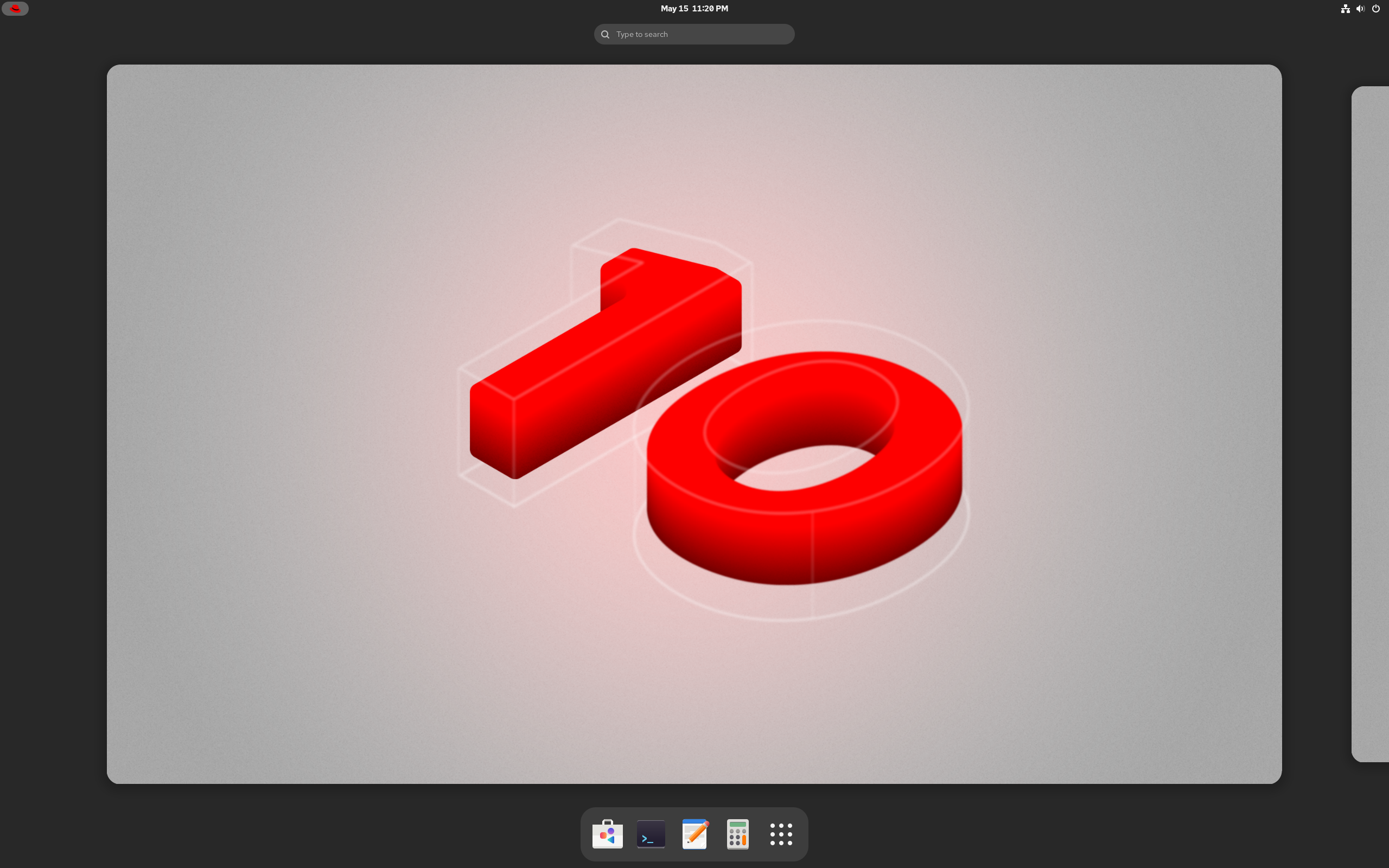
Red Hat Review
Red Hat Enterprise Linux 10.2: The Commercial Enterprise Standard the Clones Chase
Most distributions in this library are free community projects. Red Hat Enterprise Linux — RHEL — is the opposite end of that world. According to its DistroWatch listing, RHEL is a Linux distribution developed by Red Hat and targeted toward the commercial market. That single sentence explains a great deal of modern enterprise Linux: this is the reference system that budgets, support contracts, training courses and a whole family of derivatives are built around.
The newest entries in the DistroWatch feature table are RHEL 10.2 and RHEL 9.8, both released on 19 May 2026, with DistroWatch announcing them on 20 May 2026. RHEL 10.2 is listed with support until 2035 and RHEL 9.8 until 2032. DistroWatch lists the distribution as Active, categorised as Desktop and Server, based on Fedora, originating in the USA, with GNOME as its desktop. It sits at number 79 in DistroWatch’s popularity rankings with 167 hits per day, and visitors rate it 7.5 out of 10 from 17 reviews — a more divided score than its community derivatives often receive, which itself says something about the expectations paying customers bring.
That derivative family is impossible to ignore here. The community answer most readers will know first is our Rocky Linux review, which covers a system designed to be bug-for-bug compatible with RHEL. Rocky only makes sense because RHEL exists first — so this review looks at the original.
At a Glance
| Latest Release | RHEL 10.2 (19 May 2026); RHEL 9.8 also released 19 May 2026 |
| End of Life | 2035 for 10.2; 2032 for 9.8; 2029 for 8.10 |
| Base | Fedora |
| Origin | USA |
| Desktop | GNOME |
| Architectures | aarch64, ppc64el, s390x, x86_64, x86-64-v2 (feature table: arm64, IBM Z, ppc64, x86_64) |
| Installer | Graphical (ISO, approx. 800–11,000 MB for 10.2) |
| Free Download | ISO (60-day evaluation) for 10.2, per DistroWatch |
| Package Formats | Flatpak, RPM |
| Package Management | DNF, YUM |
| Release Model | Fixed |
| Init System | systemd |
| Journaled File System | XFS |
| Default Browser | Firefox ESR |
| Price | Commercial — DistroWatch links to Red Hat pricing rather than listing a single price |
| DistroWatch Popularity | 79 (167 hits per day) |
| Visitor Rating | 7.5/10 from 17 reviews |
Built for the Commercial Market, Not the Hobbyist Desktop
DistroWatch’s description is unusually direct about intent: RHEL is targeted toward the commercial market. The listing adds that Red Hat Enterprise Linux is released in server editions for x86, x86_64, Itanium, PowerPC and IBM System z architectures, and desktop editions for x86 and x86_64 processors, and that all of Red Hat’s official support and training, and the Red Hat Certification Program, centres around the RHEL platform. In other words, the operating system is only part of the product — support, training and certification are part of it too.
That helps explain why the mechanics listed by DistroWatch are deliberately conservative: a fixed release model, a graphical installer, GNOME as the default desktop, systemd as the init system, XFS as the journaled file system, Firefox ESR as the default browser, and RPM packages managed with DNF and YUM, with Flatpak also listed. Nothing there is chasing novelty. Upstream, the experimentation happens in the project covered by our Fedora review — DistroWatch lists Fedora as RHEL’s base, which is where newer technology tends to appear before it is hardened for enterprise use.
Source Code, Trademarks, and the Derivatives That Followed
One of the most consequential paragraphs on the DistroWatch listing concerns redistribution. DistroWatch notes that Red Hat uses strict trademark rules to restrict free re-distribution of its officially supported versions of RHEL, but still freely provides its source code, and that third-party derivatives can be built and redistributed by stripping away non-free components.
That arrangement is the seed of an entire ecosystem. Alongside Rocky, our AlmaLinux review covers another leading community project pursuing RHEL compatibility, and our CentOS review covers the distribution that for years filled the free enterprise role for many server rooms. Reading RHEL on its own terms matters, though: the derivatives aim at compatibility with this system, its packages and its behaviour. If you want to understand why they make the choices they do, start with the commercial original they are matching.
Three Generations Running in Parallel, Support Into the 2030s
The DistroWatch feature table shows three current RHEL generations side by side, and their dates set the enterprise tempo. RHEL 10.2, released 19 May 2026, is supported until 2035. RHEL 9.8, released the same day, runs until 2032. RHEL 8.10, released 20 May 2024 in the table, runs until 2029. Older lines in the same table reach back through 7.9, 6.9 and beyond, underlining how long a single major version is expected to stay in service.
Get The Polymarket App - Get $50
The recent release history on the listing shows the same overlap: 10.2 and 9.8 together in May 2026, preceded by 10.1 and 9.7 on 12 November 2025 and 10.0 on 20 May 2025. For an organisation, that parallelism is the point — a newer generation can be adopted on a planned schedule rather than because the old one was abandoned. DistroWatch lists ISO image sizes for 10.2 from roughly 800 to 11,000 MB, and a free download in the form of an ISO with a 60-day evaluation, which is the practical way to test RHEL before committing to commercial terms.
From ARM to IBM Z
RHEL 10.2 is not an x86-only system. DistroWatch’s summary lists its architectures as aarch64, ppc64el, s390x, x86_64 and x86-64-v2, while the feature table expresses the 10.2 processor architectures as arm64, IBM Z, ppc64 and x86_64. In plain terms, that covers conventional x86_64 servers and workstations, ARM systems, IBM POWER and IBM Z mainframes.
The package table gives a sense of the curated, fixed-release character: for RHEL 10.2 DistroWatch lists, among others, kernel 6.12, GNOME Shell 49.4, systemd 257, Firefox 140.10.0 in the package comparison, and glibc 2.39 — versions chosen for a supported enterprise release rather than the newest available anywhere. The 9.8 column lists LibreOffice 7.1.8 as its office suite, while the 10.2 column lists no office suite, a detail worth checking in the image you actually deploy.
Who Should Try Red Hat Enterprise Linux?
- Businesses that need official support, training and certification — DistroWatch notes that Red Hat’s official support and training and the Red Hat Certification Program centre around RHEL.
- Administrators building a career in enterprise Linux — learning the system the derivatives aim to match, including Rocky and AlmaLinux’s take on RHEL compatibility, is a direct route into that job market.
- Organisations planning a decade ahead — 10.2 support until 2035 and 9.8 until 2032, per DistroWatch, with three generations maintained in parallel.
- Teams on mixed enterprise hardware — arm64, IBM Z, ppc64 and x86_64 architectures are listed for 10.2.
- Evaluators before they buy — DistroWatch lists a free ISO download with a 60-day evaluation for 10.2, so the commercial decision can come after a real test.
Final Thoughts
Red Hat Enterprise Linux is the commercial centre of gravity for a large part of Linux. Its DistroWatch numbers — rank 79 with 167 hits per day and a 7.5/10 visitor rating from 17 reviews — are modest compared with some community favourites, but popularity was never its measure. A Fedora base, GNOME desktop, systemd init, XFS file system, RPM and Flatpak packages, a fixed release model and support horizons reaching 2035 add up to a system sold on predictability and backing, not excitement.
If you do not need a vendor behind your operating system, a community derivative such as the one in our Rocky Linux review may give you a very similar technical experience for free. If you do need that vendor — for support, training, certification or accountability — then RHEL 10.2 is the original article, and the 60-day evaluation listed by DistroWatch is the sensible place to start.
Source: DistroWatch’s Red Hat Enterprise Linux listing, covering the RHEL 10.2 and 9.8 releases of 19 May 2026.