AlmaLinux Review
AlmaLinux OS 10.2 Review: The Community Enterprise Linux
An open-source, community-driven Linux distribution built from the source code of Red Hat Enterprise Linux — 100% binary compatible with RHEL, maintained by a non-profit foundation, and free for everyone, from home labs to production servers.
AlmaLinux OS has one of the clearest missions in the Linux world. According to the DistroWatch listing, it is an open-source, community-driven project built from the source code of Red Hat Enterprise Linux (RHEL), a completely binary-compatible fork maintained by the AlmaLinux OS Foundation, a registered non-profit. If you were following the shift that reshaped the enterprise Linux landscape, our CentOS review covers the project that used to occupy exactly this role — AlmaLinux is the community’s answer to keeping that free, RHEL-compatible option alive.
The current listed release is AlmaLinux OS 10.2, announced on May 26, 2026 alongside AlmaLinux OS 9.8. That paired release says a lot about how this project is run: the 10.x line is the current major generation, while the 9.x line keeps receiving updates for users on long support cycles. The DistroWatch release history shows a steady drumbeat — 8.10 in May 2024, 9.5 and 9.6, 10.0 in May 2025, 10.1 in November 2025, then the 10.2/9.8 pair in May 2026 — with beta builds like AlmaLinux OS 9.9 Beta 1 (September 2026) feeding the development pipeline. For perspective on where RHEL itself begins upstream, our Fedora review covers the distribution whose sources sit at the start of this whole family tree.
AlmaLinux OS 10.2 at a Glance
| Distribution family | Open-source, community-driven project built from RHEL source; binary compatible with RHEL |
|---|---|
| Current listed release | AlmaLinux OS 10.2 (and AlmaLinux OS 9.8), released May 26, 2026 |
| Maintainer | AlmaLinux OS Foundation, a registered non-profit |
| Recent release history | 10.0 (May 2025), 10.1 (November 2025), 10.2 (May 2026); 9.5–9.8 on the 9.x line; 8.10 (May 2024) |
| Desktops | GNOME, KDE Plasma, MATE |
| Categories | Desktop, Server, Raspberry Pi |
| Supported architectures | aarch64, ppc64le, s390x, x86_64 |
| Price | Free |
| Origin | USA |
| Status | Active |
| DistroWatch popularity | 48 (245 hits per day) |
| Average visitor rating | 8.0/10 from 71 reviews |
Feature details and version information are based on the DistroWatch AlmaLinux OS listing.
A True Community RHEL Alternative
The single most important thing on the DistroWatch listing is the governance model. AlmaLinux OS is built from the source code of Red Hat Enterprise Linux and describes itself as a completely binary-compatible fork of RHEL — meaning software and workflows built for RHEL run on it unchanged. Crucially, it is maintained by the AlmaLinux OS Foundation, a registered non-profit, not by a company with its own subscription business. That community ownership is the project’s core promise: enterprise-grade Linux with no vendor gatekeeping, no subscriptions, and no expiration date.
It is free, it is active, and it has been around long enough to prove the model works. For anyone who once deployed CentOS Linux on servers — and our CentOS review explains what changed upstream — AlmaLinux is the natural spiritual successor: same RHEL compatibility, but with the community in charge of the keys.
Built for Servers, Comfortable on Desktops
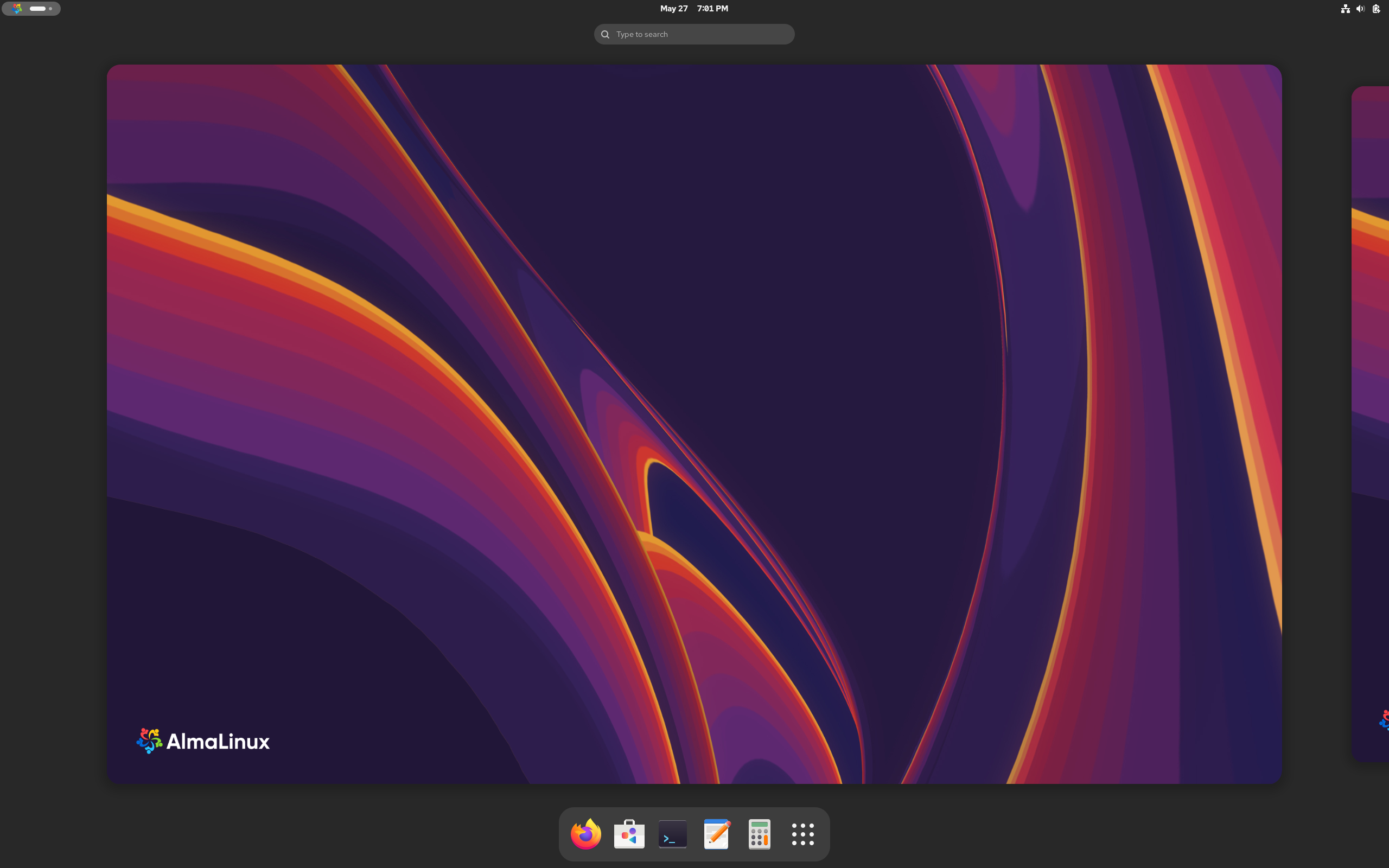
DistroWatch files AlmaLinux under three categories: Desktop, Server, and Raspberry Pi. That trio tells the story of a distribution that is first and foremost a server operating system — long support windows, conservative package choices, minimal churn — but doesn’t abandon the workstation user. The listed desktops are GNOME (the enterprise default), KDE Plasma (for users who want a more configurable modern desktop), and MATE (the classic, lightweight option).
If your needs are purely desktop-flavored, distributions like Mint or Ubuntu are tuned for that from the start — see our Ubuntu review for the most popular desktop Linux of all. But if you want one system image that you can run on a server fleet and then sit in front of yourself, AlmaLinux’s dual identity is the appeal: learn it once, deploy it everywhere.
Two Supported Lines: 9 and 10
Enterprise distributions age differently from desktop ones, and AlmaLinux’s release history shows the pattern clearly. The current generation, AlmaLinux 10.x, debuted with 10.0 in May 2025, gained 10.1 in November 2025, and reached 10.2 in May 2026. Alongside it, the previous generation keeps marching: 9.5 (November 2024), 9.6 (May 2025), 9.7 beta (October 2025), 9.8 (May 2026), and already a 9.9 Beta 1 announced in September 2026.
That overlap is deliberate. Administrators on the 9.x line are not forced onto major upgrades the moment a new generation lands; the older branch keeps receiving releases in parallel. It’s the same philosophy that makes our Debian review such a common point of comparison — Debian Stable is the other great server-room stalwart, and it follows a similar long, predictable cadence. The difference is pedigree: where Debian marches to its own drum, AlmaLinux marches in step with RHEL.
Every Architecture That Matters
The listed architectures are aarch64, ppc64le, s390x, and x86_64 — server-room silicon, in other words. The x86_64 desktops and racks most of us run are covered, but so are ARM servers (aarch64), IBM POWER systems (ppc64le), and IBM Z mainframes (s390x). Add the Raspberry Pi category to that, and AlmaLinux clearly takes its “run it anywhere” claim seriously.
The project’s headlines reinforce the breadth: AlmaLinux expanded CPU support in April 2026, started building packages for RISC-V processors in March 2026, improved NVIDIA driver support the same month, enabled the CRB repository in September 2025, and added Btrfs support in AlmaLinux 10.1. This is an actively developed platform, not a frozen museum piece.
Who Should Try AlmaLinux?
- System administrators who want RHEL without the subscription — binary compatibility with RHEL means your RHEL-tested software, playbooks, and workflows carry over directly.
- Anyone who migrated off CentOS Linux — this is the community-driven continuation of the free enterprise-Linux idea; our CentOS review explains what changed upstream.
- Home-lab builders and self-hosters — free, stable, long-lived releases make it ideal for servers you set up once and maintain for years.
- Teams that need RHEL compatibility across unusual hardware — with aarch64, ppc64le, s390x, and x86_64 listed, plus Raspberry Pi support, one image strategy covers a lot of ground.
- Learners pursuing enterprise Linux skills — a free, binary-compatible RHEL fork is the best zero-cost lab for the ecosystem that Fedora feeds into.
Final Thoughts
AlmaLinux OS does exactly one thing, and does it with unusual clarity: free, community-owned, binary-compatible enterprise Linux. The DistroWatch listing shows a project with steady releases on two concurrent lines, support for every architecture that matters in the server room, three solid desktop choices, a non-profit foundation holding the keys, and an 8.0/10 visitor rating from 71 reviews to back it up. At #48 in the popularity rankings, it isn’t a desktop darling — and it doesn’t try to be. It’s a workhorse.
If you evaluate server distributions, the shortlist is small: this one, Debian (covered in our Debian review), and Ubuntu LTS (see our Ubuntu review). AlmaLinux’s unique selling point among them is its direct RHEL compatibility under community, non-profit control. For shops running RHEL software without RHEL licenses — or simply anyone who believes infrastructure Linux should belong to its community — AlmaLinux OS 10.2 is the clearest choice in the field.
Source: the DistroWatch.com AlmaLinux OS listing (table.php?distribution=almalinux), listing AlmaLinux OS 10.2 as the current release, last updated May 26, 2026.