Tails Review
Tails 7.14: The Amnesic Live System That Routes Everything Through Tor
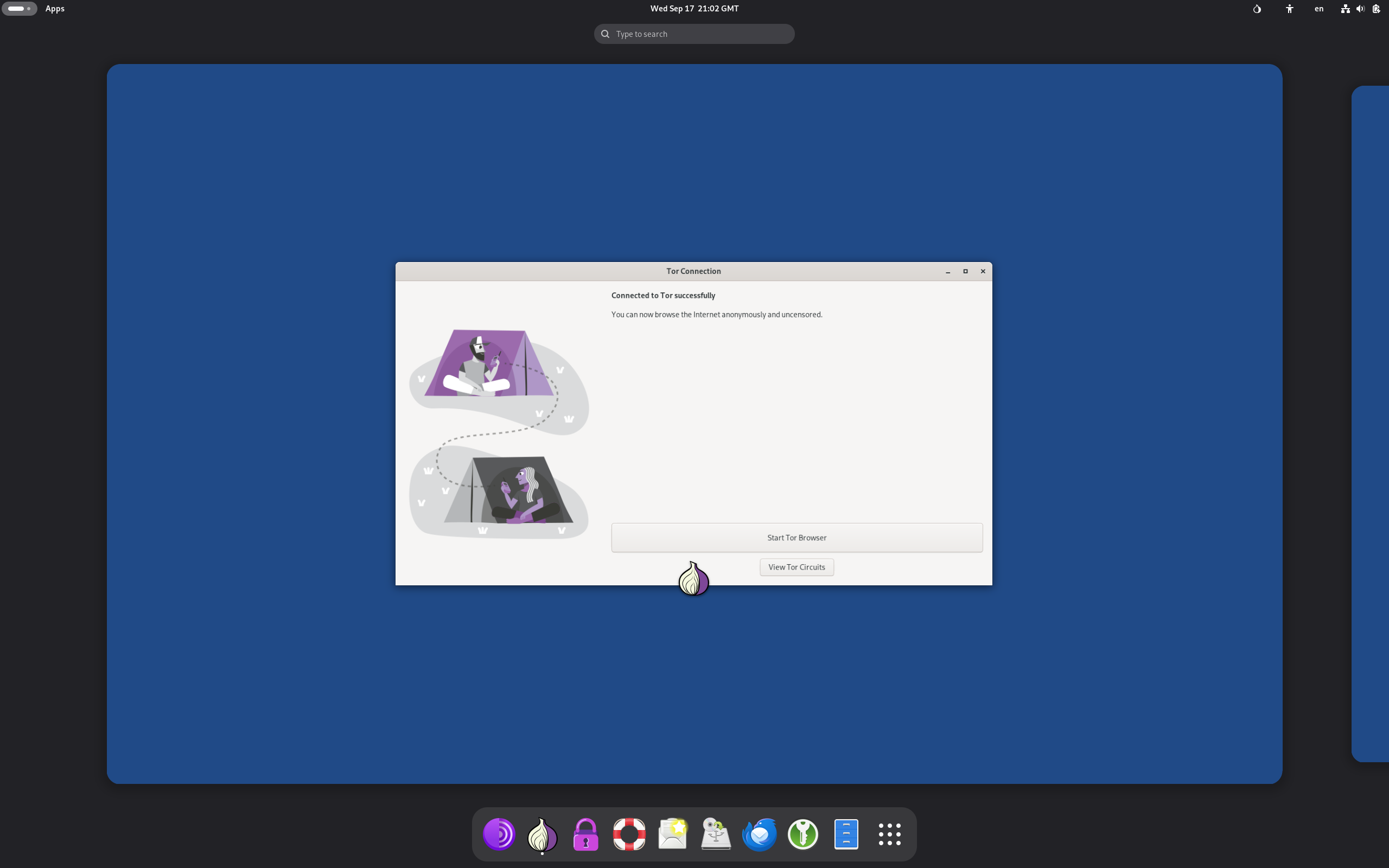
Most Linux distributions want to be your daily driver — installed on the hard drive, configured to your taste, carrying your files for years. Tails takes the opposite stance: it never wants to remember you at all. Tails is The Amnesic Incognito Live System, a Debian-based live DVD/USB whose stated goal is complete Internet anonymity for the user. It ships with a web browser, IRC client, mail client, and instant messenger, all pre-configured with security in mind — and all traffic anonymised through the Tor network, which the DistroWatch description notes is what makes Internet traffic very hard to trace.
The latest release listed on DistroWatch is Tails 7.14, released on September 30, 2026. It is a free download (the image runs roughly 1.7–1.8 GB and is offered as both ISO and IMG), boots into the GNOME desktop, and ships Tor Browser as its default browser. Under the privacy tooling sits reassuringly familiar machinery: a Debian (Stable) base, APT package management with DEB and Flatpak formats, the systemd init system, a fixed-release model, and 64-bit x86 targets. DistroWatch lists Tails in the Load To RAM, Live Medium, Privacy, and Security categories with an “Active” status.
If you follow specialist security distributions, Tails sits in the same specialist camp as our Kali review — but where Kali is built for testing other systems’ security, Tails is built to protect the security of the person using it.
At a Glance
| Distribution | Tails (The Amnesic Incognito Live System) |
| Current listed release | 7.14, released September 30, 2026 |
| Based on | Debian (Stable) |
| Origin | Ireland |
| Desktop | GNOME |
| Default browser | Tor Browser |
| Specialty | Privacy and anonymity (all traffic routed through Tor) |
| Installer | None — live-only system, booted from DVD or USB |
| Package management | APT, DEB and Flatpak formats |
| Release model | Fixed release |
| Architecture | x86_64 |
| Init system | systemd |
| Languages listed | German, English, Spanish, French, Italian, Portuguese |
| Price | Free |
| DistroWatch popularity | Rank 39 (277 hits per day); visitor rating 5.7/10 from 24 reviews |
Feature details and version information are based on the DistroWatch Tails listing for release 7.14.
Amnesia as a Feature
The name is the mission statement. “Amnesic” means the system is designed to forget: Tails boots from a USB stick or DVD, can load itself into RAM, and leaves no trace of the session on the host computer once it is shut down. That is why DistroWatch’s release table lists no installer at all — there is nothing to install in the traditional sense. You write the image to a stick, boot it, and the whole operating system exists in the moment.
This is the fundamental inversion of how desktop Linux normally works. A conventional distribution accumulates state — configs, caches, browser histories, documents — and that accumulation is what makes it convenient. Tails treats accumulation as the threat. For journalists, activists, researchers, or anyone who needs to use an unfamiliar or untrusted computer without leaving a footprint, that inversion is the entire point of the product.
Tor Is the Network Stack, Not an Option
On most distributions, privacy is a configuration project: install a VPN, harden a browser, remember not to leak DNS. Tails makes anonymity structural instead of optional. According to the DistroWatch description, the system ships its Internet applications — web browser, IRC client, mail client, instant messenger — pre-configured with security in mind, with all traffic anonymised, because the whole system routes through the Tor network.
The default browser is Tor Browser, and the bundled communication tools are set up so that nothing reaches the network in the clear by accident. That matters because anonymity failures are rarely dramatic — they are a single unproxied connection, a forgotten setting, a background updater phoning home. By forcing every byte through Tor at the system level, Tails removes the class of mistake where a user does everything right except one thing they forgot to configure.
Debian Stable Under the Hood
For all its specialism, Tails is reassuringly ordinary where it counts. It is based on Debian (Stable) — the same rock-solid foundation covered in our Debian review — manages software with APT in the DEB format (with Flatpak support added in recent releases), follows a fixed-release model, and boots with systemd. If you know Debian, the package layer, the terminal, and the system layout will feel like home.
The 7.14 package list tracked by DistroWatch shows how current the stack stays despite the fixed-release model: Linux kernel 7.2.8, GNOME Shell 51, Wayland 1.26, and Thunderbird 157 among the tracked packages. The distribution follows Debian Stable’s cadence, which is exactly what you want from a privacy tool — a conservative, well-tested base where surprises are a bug, not a feature. That Debian-rooted practicality also makes Tails philosophically closer to another Debian-based option like MX Linux than to rolling-release experiments: stability first, then the special sauce on top.
A GNOME Desktop With One Job
Tails ships the GNOME desktop — every release line in DistroWatch’s table, from the old 0.6 series through 7.14, lists GNOME as the default. It is a sensible choice for the mission: GNOME is a polished, mainstream environment that does not demand Linux expertise from someone whose expertise might be journalism or field research rather than system administration. The desktop speaks six listed languages (German, English, Spanish, French, Italian, and Portuguese), which fits a tool meant for a global audience.
There is a certain irony in GNOME’s modern polish sitting atop a system designed to forget you. But it is a deliberate one: anonymity tools only work if people actually use them, and people use tools that feel like a normal computer. Tails looks like a normal computer. It just refuses to keep a diary.
Who Should Try Tails?
- Journalists and researchers who need to browse, communicate, and publish without revealing their location or identity — or leaving traces on the machine they used.
- Activists and dissidents working under surveillance or censorship, for whom an amnesic system routed entirely through Tor is a safety tool, not a hobby.
- Privacy-curious users who want to experience what a fully Tor-routed desktop feels like, without committing to any installation — boot it from a USB stick on any spare machine.
- Travelers on untrusted hardware — Internet café machines, borrowed laptops, conference kiosks — where the safest assumption is that the host cannot be trusted with your data.
- Fans of purpose-built specialist distributions — in the same spirit as our DragonOS review, which covers a distro built for one specialist job (radio) rather than general use.
- Debian users who want the familiar APT-based Debian machinery extended into a privacy-first live environment.
Final Thoughts
Tails is the clearest example in the Linux world of software designed around a single promise: nobody — not the network, not the host computer, and not the system itself — should be able to reconstruct what you did. The amnesic live design, the mandatory Tor routing, and the conservative Debian Stable base all serve that one promise, and DistroWatch’s “Active” status with a steady release cadence shows the project keeps that promise maintained.
It is not, and does not pretend to be, a daily driver. It will not remember your files, your settings, or your tabs — that is the feature, not the limitation. But for the moments when forgetting matters more than remembering, Tails 7.14 remains the purpose-built answer, free to download and ready to boot.
Source: DistroWatch: Tails page. Information cited in this post reflects the DistroWatch listing for Tails release 7.14, dated September 30, 2026.