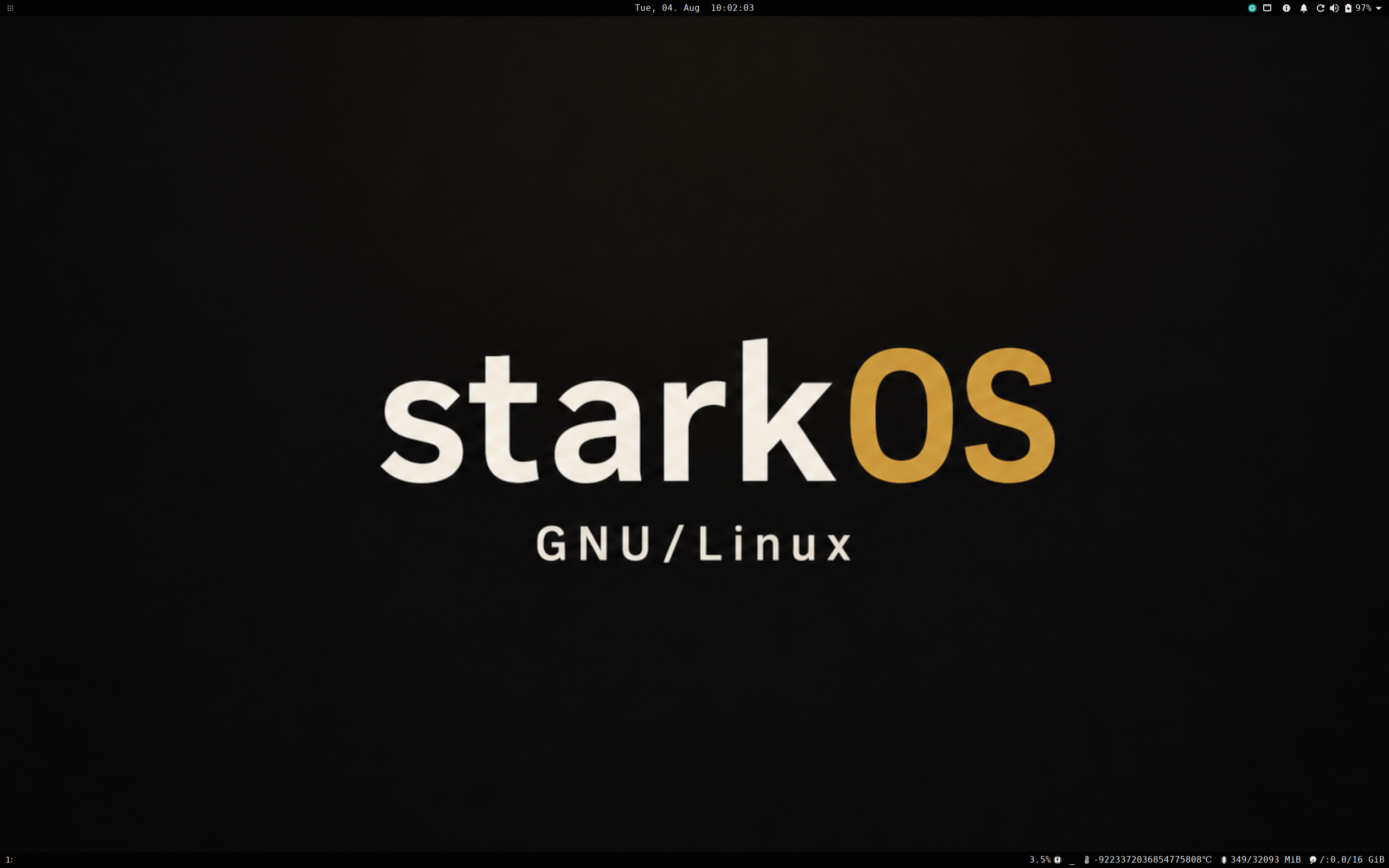
starkOS Review
starkOS 20260910: A Source-Based, Rolling System Built Around Sway
Some distributions try to make Linux invisible. starkOS does the opposite. According to its DistroWatch listing, starkOS is an independently-developed GNU/Linux distribution designed for experienced Linux users. It uses a ports system and the stark package manager to install and update software from source code — a deliberate, hands-on approach that puts building and understanding the system ahead of one-click convenience.
The latest release in DistroWatch’s feature table is starkOS 20260910, released on 10 September 2026. It is free, listed as Active, and categorised by DistroWatch as a Desktop and Live Medium distribution for x86_64 hardware. It currently sits at number 265 in DistroWatch’s popularity rankings with 56 hits per day, and it has no visitor rating yet — a sign of how new and niche this project still is.
That experienced-user focus will sound familiar to readers of our Void Linux review, another independent, rolling system that expects you to know what you are doing. starkOS goes its own way, though: where Void builds around its own binary packages and runit, starkOS compiles from source through ports and lets you choose your init system outright.
At a Glance
| Latest Release | 20260910 (10 September 2026) |
| Base | Independent |
| Origin | Unknown (per DistroWatch) |
| Desktop | Sway |
| Architectures | x86_64 |
| Installer | No installer in the live system; install via separately provided rootfs filesystems, text-mode installation listed by DistroWatch |
| Package Management | stark — src format, ports system, built from source code |
| Release Model | Rolling |
| Init System | Choice of runit, s6 or SysV (via rootfs) |
| Filesystems | Btrfs, ext4, XFS (journaled, per DistroWatch) |
| Default Browser | Firefox |
| Price | Free (image size approx. 2,400–2,500 MB) |
| DistroWatch Popularity | 265 (56 hits per day) |
| Visitor Rating | No visitor rating given yet |
Built From Source, the Ports Way
The heart of starkOS is its ports system. DistroWatch says the project uses a ports system and the stark package manager to install and update software from source code, and its release table lists the package format simply as “src” with stark as the package management tool. There are no pre-built binaries doing the work for you here — software is compiled on your machine.
AWS Alternative - Digital Ocean
That is a philosophy with a long lineage in Linux, most famously in our Gentoo review, where building from source is also central. starkOS applies a similar idea in a much smaller, newer project, with its own manager rather than a borrowed one. The trade-off is clear: you gain control over how software is built, and you pay for it in compile time and in the knowledge needed to steer the process.
No Installer in the Live Image — and a Choice of Init
Getting starkOS onto a disk is intentionally manual. DistroWatch explains that the project provides a lightweight live image, but the live system does not include an installer; however, starkOS can be installed to a hard disk using one of the rootfs filesystems provided separately, with a choice of runit, s6 or SysV init software.
US Mobile | Plans As Low As $10, Get $30 Instantly
That init choice is a defining feature. Most distributions pick one init system for you; starkOS offers three in its rootfs options. Readers who value that freedom will recognise it from our Artix review, which also built its identity around offering alternatives to a single imposed init. Here the choice is baked into how you install in the first place, rather than added afterwards.
Sway on Wayland, Kept Lightweight
For its desktop, starkOS keeps things lean. DistroWatch lists Sway as its desktop, and describes the live image as a lightweight live image with the Sway Wayland compositor and some basic software on it. Firefox is listed as the default browser in the release table, and supported languages are English and Spanish.
Free Credit Score Monitoring At Sofi
Sway is a tiling Wayland compositor, so this is a keyboard-driven, minimal graphical environment rather than a traditional point-and-click desktop suite. That fits the project’s stated goal, as DistroWatch puts it: to develop a Linux distribution that is simple, lightweight, up-to-date and extensible. A rolling release model, listed in the release table, is how the “up-to-date” part is delivered — the system evolves continuously rather than waiting for the next big version.
Who Should Try starkOS?
- Experienced Linux users — DistroWatch says starkOS is designed for experienced users; with no installer in the live system and a manual rootfs install, this is not a beginner distribution.
- Source-based fans — if building software from source through a ports system appeals to you, and Gentoo’s source-based approach feels too large in scope, starkOS offers a smaller take on the same idea with its stark manager.
- Init-system choosers — the separately provided rootfs filesystems offer runit, s6 or SysV, per DistroWatch, so you can run the init you actually prefer.
- Sway and Wayland users who want a lightweight live system — DistroWatch describes a lightweight live image with Sway and basic software, categorised as Desktop and Live Medium, free to download at roughly 2,400–2,500 MB.
- Tinkerers who want a system that stays current — a rolling release model on an independent base, built to be simple, lightweight, up-to-date and extensible, per DistroWatch.
Final Thoughts
starkOS 20260910 is a small, opinionated project that makes no attempt to be for everyone. An independent base, a ports system with the stark package manager building software from source, a rolling release model, Sway on Wayland, and a manual install that lets you pick runit, s6 or SysV add up to a system for people who want to assemble and understand what they run. Its DistroWatch rank of 265 and lack of a visitor rating yet reflect how early this story is — but for experienced users tired of distributions deciding everything for them, that spareness is exactly the point.
Source: DistroWatch’s starkOS listing, covering the starkOS 20260910 release of 10 September 2026.