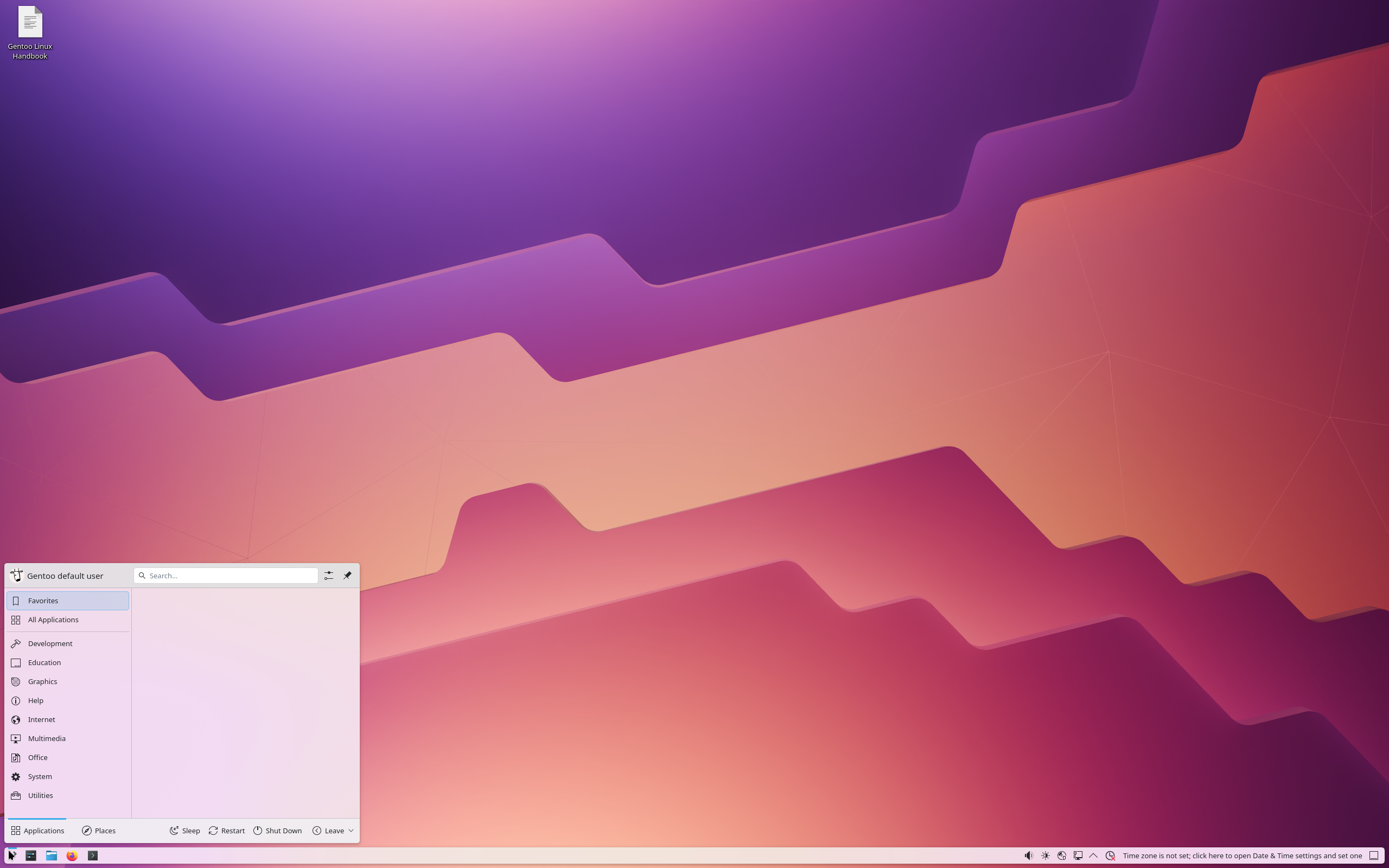
Gentoo Review
Gentoo Linux: The Source-Based Distribution You Compile Yourself
Gentoo Linux is a versatile and fast, completely free Linux distribution geared towards developers and network professionals, according to its official DistroWatch listing. It is independently developed — not based on any other distribution — and originates in the USA. Where most distros hand you a finished product, Gentoo hands you the source code and trusts you to build it.
That trust is the whole philosophy. Gentoo’s DistroWatch listing categorizes it as a source-based distribution: instead of installing pre-compiled binary packages, software is built on your machine by Portage, Gentoo’s advanced package management system. Our Arch Linux review covers another proudly independent distro with the same do-it-yourself spirit — but where Arch optimizes for packaging simplicity, Gentoo optimizes for control.
And control is what you get: no default desktop, no fixed release schedule, support for eleven processor architectures, and a package manager that lets you tune nearly every aspect of how software is built. It is not the easiest path in Linux, but for those who want it, there is nothing else quite like it.
All facts in this review are drawn from Gentoo’s official DistroWatch listing.
At a Glance
| Based on | Independent |
| Origin | USA |
| Status | Active |
| Category | Desktop, Raspberry Pi, Server, Source-based |
| Package manager | Portage (Python-based ports system) |
| Desktops available | Awesome, Blackbox, Enlightenment, Fluxbox, GNOME, IceWM, KDE Plasma, LXDE, MATE, Sway, Openbox, WMaker, Xfce (no default — your choice) |
| Architecture | aarch64, alpha, arm, hppa, i686, mips, powerpc, ppc64, sparc64, x86_64, x86-64-v3 |
| Releases | No numbered releases; last announced: 20160514 (2016-05-28) |
| Price | Free |
| DistroWatch rank | #63 (198 hits per day) |
| Reader rating | 8.8/10 from 95 reviews |
Portage: A Ports System, Not Just a Package Manager
The centerpiece of Gentoo is Portage, which its DistroWatch listing describes as “an advanced package management system” and “a true ports system in the tradition of BSD ports, but Python-based.” It sports advanced features including dependencies, fine-grained package management, “fake” (OpenBSD-style) installs, safe unmerging, system profiles, virtual packages, and config file management. This is where Gentoo’s reputation comes from: every package can be shaped to your machine, and nothing gets installed that you did not ask for.
Get The Polymarket App - Get $50
Contrast that with binary distros: even our CachyOS review covers a performance-tuned distro, but it achieves speed with pre-built, optimized binaries. Gentoo’s answer is to compile the software itself, tuned to your exact machine — slower to install, uniquely yours once it is done.
No Defaults: Thirteen Desktops, Zero Presumption
Gentoo’s DistroWatch listing names thirteen desktop environments and window managers — Awesome, Blackbox, Enlightenment, Fluxbox, GNOME, IceWM, KDE Plasma, LXDE, MATE, Sway, Openbox, WMaker, and Xfce — and pointedly leaves the “default” question unanswered. There isn’t one. You choose, and the system you end up with reflects your decisions, not a product manager’s.
That is the polar opposite of an opinionated desktop: our Linux Mint review covers a distro that makes sensible choices up front so you can get to work. Gentoo assumes you would rather make them yourself — and if that assumption is right, nothing else will satisfy you.
From Raspberry Pi to Exotic Silicon
Gentoo’s architecture list reads like a computer history museum: aarch64, alpha, arm, hppa, i686, mips, powerpc, ppc64, sparc64, x86_64, and x86-64-v3. Its categories span Desktop, Server, Raspberry Pi, and Source-based. A source-based approach means Gentoo is at home on hardware most distros never touch — the same system that runs your desktop can be built for a PowerPC workstation or a Raspberry Pi.
Still Moving Forward
Gentoo’s status on DistroWatch is Active, and the project’s recent headlines back that up: it migrated its development to Codeberg in February 2026, started offering QCOW2 disk images in 2025, and DistroWatch itself ran a “Reasons to run Gentoo” feature in July 2026. With a visitor rating of 8.8/10 from 95 reviews and a steady page-hit ranking around #63, this is a project with a loyal, long-term following.
For another angle on a source-built system with a devoted community, our NixOS review covers a distro that takes reproducibility — rather than compilation — as its defining idea.
Who Should Try Gentoo?
- Developers and network professionals who want to know exactly what is on their system — the audience Gentoo names for itself
- Tinkerers who want fine-grained control over how every package is built
- Anyone running unusual or older hardware, from a Raspberry Pi to a SPARC workstation
- Learners who want a deep education in how a Linux system fits together
- Minimalists who want a system with nothing on it they did not choose
If you want an installer that makes the decisions for you, Gentoo is not that — and that is entirely the point.
Final Thoughts
Gentoo Linux is not for everyone, and it does not pretend to be. It is for the developers and network professionals it names as its audience: people who want to build their system from source, choose every component, and know exactly why everything is there. Independent, source-based, and still actively developed, Gentoo remains the definitive answer to the question “what if I want it my way, all the way down?”
Source: DistroWatch — Gentoo Linux, last announced release 20160514 (2016-05-28). All facts in this review are drawn from that listing.