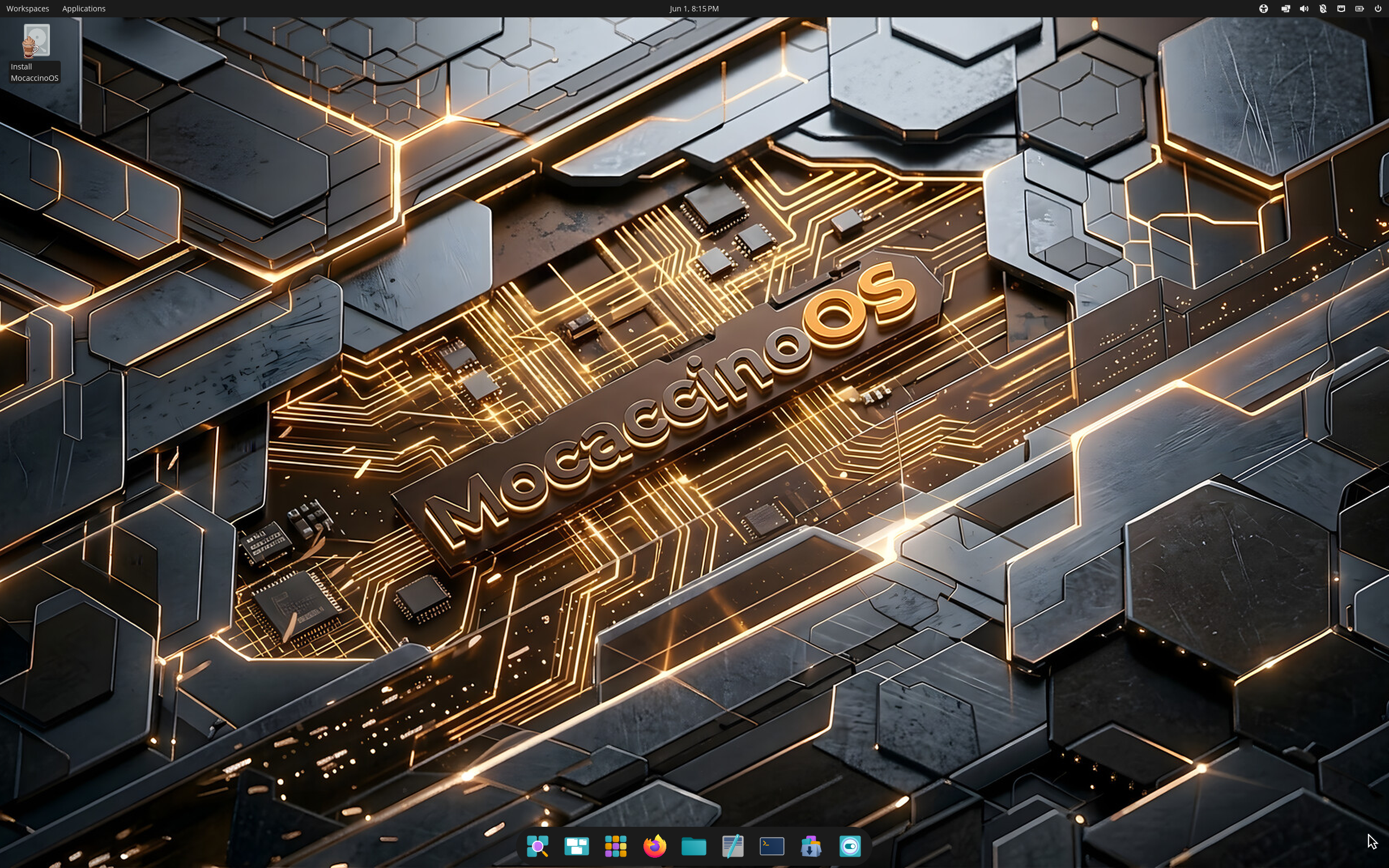
MocaccinoOS Review
MocaccinoOS 26.06: Gentoo Roots, Container-First Packaging
MocaccinoOS is an independently-developed Linux distribution that traces its origins to source-based Gentoo Linux and Sabayon Linux. That is DistroWatch’s description, and it frames everything about the project: this is not another Ubuntu respin or Debian remix. It is a from-scratch Italian project with its own custom-built package manager — Luet, which DistroWatch describes as a front-end for container-based software.
The latest release listed on DistroWatch is MocaccinoOS 26.06, announced June 1, 2026. DistroWatch places it at rank 58 in its six-month page-hit ranking (204 hits per day), with an average visitor rating of 7.9 out of 10 across 8 reader reviews. Recent releases follow calendar-style YY.MM versioning — 26.06 in June, 26.03 in February, 25.09 last September — a steady cadence of scheduled snapshots. If the Gentoo lineage is what catches your eye, our Gentoo review covers the source-based ancestor this project grew out of.
DistroWatch files MocaccinoOS under Desktop, Immutable, and Live Medium. The project’s own stated pillars are minimalism and a small footprint, ease of use, native vanilla Linux kernels, and support for the most important cloud technologies. It is offered in several variants: live images with GNOME, KDE Plasma, MATE and Xfce desktops, plus a command-line-only “Minimal Desktop” edition.
MocaccinoOS 26.06 at a Glance
| Feature | MocaccinoOS 26.06 |
| Release date | June 1, 2026 (per DistroWatch) |
| OS type | Linux |
| Based on | Independent (origins in Gentoo Linux and Sabayon Linux) |
| Origin | Italy |
| Desktop | COSMIC, Fluxbox, GNOME, KDE Plasma, LXQt, MATE, niri, Openbox, Sway, Xfce |
| Architectures | x86_64 |
| Category | Desktop, Immutable, Live Medium |
| Status | Active |
| Package management | Luet (custom-built, container-based front-end) |
| Editions | Live images with GNOME, KDE Plasma, MATE, Xfce; command-line-only Minimal Desktop |
| DistroWatch popularity | Rank 58 (204 hits per day, six-month ranking) |
| Average visitor rating | 7.9/10 from 8 reviews |
| Previous releases | 26.03 (February 28, 2026), 25.09 (September 8, 2025), 1.8.3 (July 5, 2025) |
Luet: A Container-Native Package Manager
The single most distinctive thing about MocaccinoOS is Luet. Most distributions build on an inherited package manager — apt, dnf, pacman — and the choice of base distro usually settles the question. MocaccinoOS went its own way instead: Luet is a custom-built manager that DistroWatch describes as a front-end for container-based software, meaning packages arrive as self-contained container artifacts rather than traditional archive-based packages.
That design decision connects directly to the project’s cloud-technology emphasis. Containers are the currency of modern cloud infrastructure, and a distribution whose native package format speaks containers is aimed at people who think in registries and image layers. If that philosophy appeals to you, our NixOS review covers another independent distribution built around reproducible, declarative software management — a different mechanism, but the same hunger for something beyond the traditional package archive.
Immutable, Minimal, and Live
DistroWatch categorizes MocaccinoOS as Desktop, Immutable, and Live Medium — a combination that tells you a lot. The immutable model means the core system is not mutated in place the way a traditional desktop is; the live-medium heritage means it is designed to boot and run from removable media. Add the project’s stated pillars — minimalism and a small footprint, ease of use, native vanilla kernels — and you get a system that aims to be lean, resilient, and portable at the same time.
Immutable Linux is having a genuine moment, and MocaccinoOS represents the independent end of that spectrum: no corporate backer, no flagship edition, just a community project from Italy pursuing the idea on its own terms. For another take on the immutable desktop, our Vanilla review covers a Debian-based project with similar ambitions. MocaccinoOS’s angle is different — smaller footprint, container-native packaging, and a live-system pedigree — which makes the two worth comparing rather than choosing between.
Try YouTube TV | Special Discount
Ten Desktops and Window Managers
The DistroWatch listing names ten available desktops and window managers: COSMIC, Fluxbox, GNOME, KDE Plasma, LXQt, MATE, niri, Openbox, Sway, and Xfce. That is an unusually broad spread for a small-footprint project — modern Wayland compositors (COSMIC, niri, Sway), the two big full-featured environments (GNOME and KDE Plasma), and a whole bench of featherweights (Fluxbox, LXQt, MATE, Openbox, Xfce) for modest hardware.
The official live-image editions concentrate on GNOME, KDE Plasma, MATE, and Xfce, with the command-line-only Minimal Desktop edition for servers, containers, and people who assemble their own environment. In practice that means you test-drive the mainstream options live, and the wider menu is there when you build your own install. Breadth of desktop choice is one of the quiet strengths of a community-driven project: there is no marketing department deciding you only get two options.
From Sabayon to Independence
MocaccinoOS’s origin story is part of its identity. Its roots are in source-based Gentoo Linux and Sabayon Linux, the project whose ideas MocaccinoOS carried forward as a fully independent distribution. It kept the Gentoo DNA — source-based thinking, a performance focus — while replacing portage-era tooling with its own container-native stack.
The result sits alone in the DistroWatch table: “Based on: Independent,” origin Italy, active status, x86_64. Independent distributions are rare in an era when most new projects start from Debian or Arch, and rarer still when they ship their own package manager. That independence is also the risk — the 8 reviews behind that 7.9/10 rating point to a small but appreciative community — but it is exactly what makes MocaccinoOS worth knowing about rather than just another entry in the rankings.
Who Should Try MocaccinoOS?
- Developers and sysadmins curious about container-native software delivery who want to try the Luet approach firsthand.
- Cloud and infrastructure users — DistroWatch’s description explicitly lists support for major cloud technologies among the project’s main features.
- Fans of minimal, live-bootable systems who like the idea of an immutable core on a small footprint.
- Experienced tinkerers comfortable with a small community project rather than a corporate-backed desktop.
- Former Sabayon users and Gentoo-curious experimenters who want to see what that tradition looks like as an independent, container-based system.
Final Thoughts
MocaccinoOS 26.06 is a reminder that the Linux world still has room for genuinely independent projects. A custom container-based package manager, an immutable design, native vanilla kernels, and ten desktops on a minimal live base make it one of the more distinctive distributions in DistroWatch’s ranking — and the calendar-paced snapshot releases keep it moving without drama.
It is not a beginner distribution, and it does not pretend to be. But if containers, immutability, or the old Sabayon spirit appeal to you, it is worth a download from the project’s SourceForge mirrors. And if you are exploring the independent-distro space more broadly, the Gentoo, NixOS, and Vanilla reviews linked above make good companions for comparison.
For release details, version history, and reader reviews, see the MocaccinoOS page at DistroWatch.