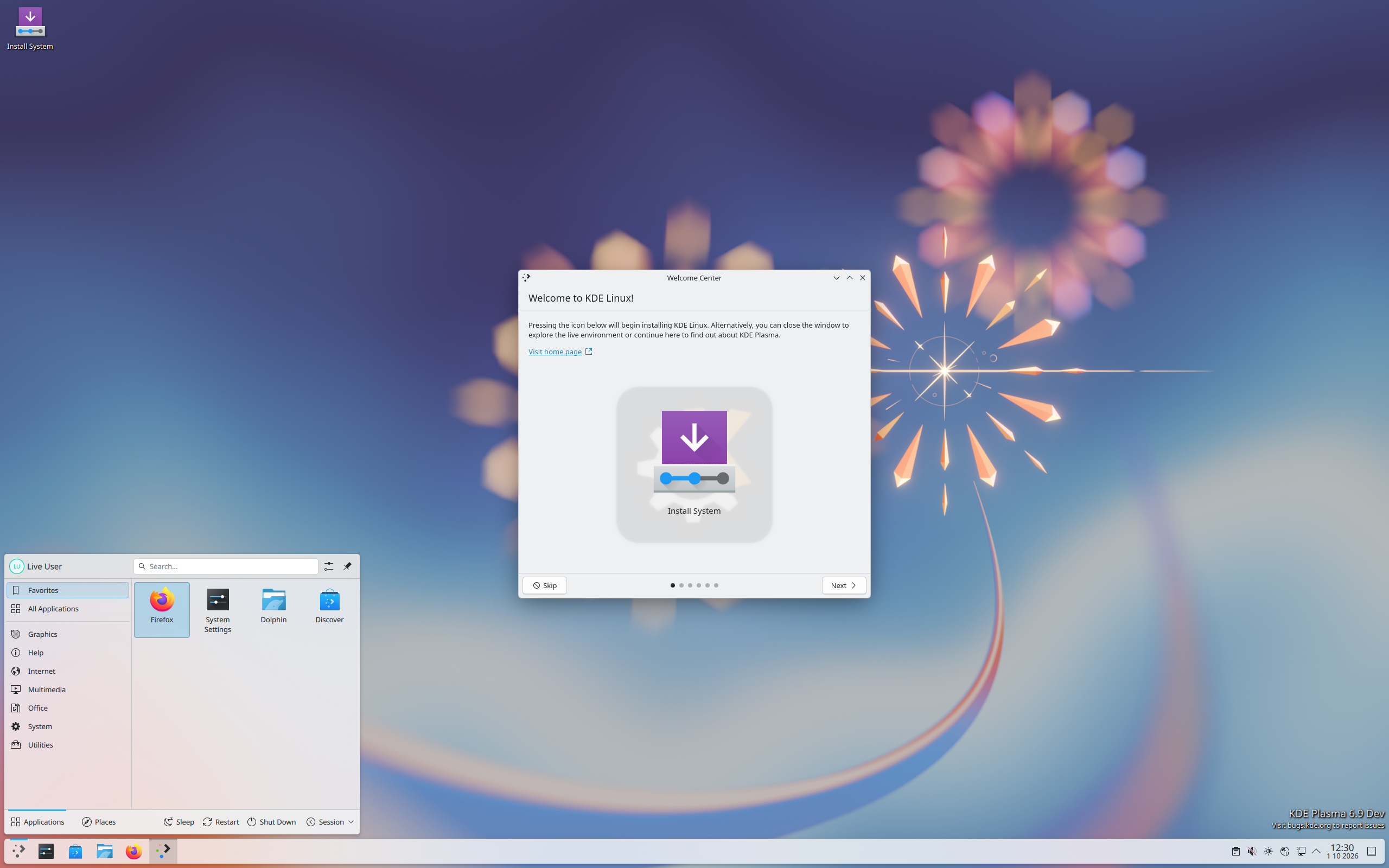
KDE Linux Review
KDE Linux 20250906: KDE’s Own Immutable Plasma Showcase
An immutable, image-based showcase of the KDE Plasma desktop — built by KDE itself, with base packages from Arch Linux, no traditional package manager, and Flatpak, Snap, and AppImage support.
According to the DistroWatch listing, KDE Linux is “a user-focused, general-purpose Linux distribution” built by KDE and “meant to showcase the best implementation of everything KDE has to offer, using the most advanced technologies.” That is a distinctive pitch: this is not a community remix of KDE software, but an operating system produced by the KDE project itself, intended as the reference implementation of its own desktop. Readers who follow KDE’s own distributions may also want our KDE neon review, which covers KDE’s other well-known Plasma vehicle.
The architecture is modern and opinionated. The distribution’s base packages come from Arch Linux, while everything else is either compiled by the kde-builder tool or included as Flatpak packages. KDE Linux ships with an immutable base, so system updates involve replacing the operating system image with an entirely new one. It does not come with any traditional package manager, but supports installing Flatpak, Snap, or AppImage applications. The latest listed release is KDE Linux 20250906, announced as a development release on September 7, 2025.
KDE Linux at a Glance
| Project | KDE Linux, built by KDE as the reference implementation of its software |
|---|---|
| Current listed release | KDE Linux 20250906, announced September 7, 2025 (development release) |
| Base | Independent; base packages come from Arch Linux, the rest compiled by kde-builder or shipped as Flatpaks |
| Desktop | KDE Plasma |
| Package management | No traditional package manager; Flatpak, Snap, and AppImage supported |
| System updates | Immutable: the whole OS image is replaced on update |
| Release model | Not listed on DistroWatch |
| Supported architectures | x86_64 |
| Categories | Desktop, Immutable, Live Medium |
| Price | Free |
| Origin | Global |
| Status | Active |
| Popularity rank | 49 (232 hits per day) |
| Visitor rating | 8.8 out of 10 from 12 reviews |
Feature details and version information are based on the DistroWatch KDE Linux listing.
The Showcase Distro, Built by KDE
Most distributions ship KDE software; KDE Linux is KDE software shipping itself. The DistroWatch description frames the project as the best implementation of everything KDE has to offer, using the most advanced technologies — which means Plasma, the KDE application stack, and the KDE system services are configured the way their own developers intend, with no downstream distribution’s customizations layered on top.
That matters if you care about the reference experience. Where other distributions adapt KDE software to their own defaults, KDE Linux is the project’s own statement of how its desktop should feel out of the box. If you want to compare approaches, our KDE neon review covers KDE’s longer-running effort on the same idea, built on a different foundation.
Free Credit Score Monitoring At Sofi
Immutable at the Core
KDE Linux has an immutable base: instead of updating packages in place, each system update replaces the entire operating system image with a new one. That is the same design philosophy behind the new generation of atomic and image-based desktops, and it changes the maintenance story — updates become atomic and predictable, and a bad update can be rolled back rather than repaired.
There is no traditional package manager at all. Application installation happens through Flatpak, Snap, or AppImage, which keeps the base image untouched while user software lives in sandboxed or self-contained formats. If the immutable model appeals to you, our Vanilla OS review covers another distribution built around the same ideas, from a different project and with a different desktop.
Refinance Your Student Loan At Sofi
Arch Under the Hood, KDE on Top
The foundation is split in an interesting way. The base packages come from Arch Linux — giving the project access to a large, current software pool — while everything above the base is either compiled by the kde-builder tool or delivered as Flatpak packages. The result is Arch-adjacent under the hood but distinctly KDE-flavored on top.
Arch-curious users who like the idea of a current base but want something curated should also look at our CachyOS review, which covers an Arch-based desktop tuned for performance, or our Arch Linux review for the do-it-yourself original.
Early Reception and Momentum
DistroWatch records KDE Linux at popularity rank 49 with 232 hits per day, and the recent trend lines show momentum: the one-week reading climbed to rank 36 with 400 hits per day. The average visitor rating sits at 8.8 out of 10 from 12 reviews — a strong early score for a young project.
The news entries on the listing suggest active development: a 2026-02-09 item notes that KDE Linux reduced the size of its daily updates — consistent with an image-based system that iterates frequently — and the project shipped alongside the broader KDE ecosystem’s milestones, including KDE’s 30th anniversary in September 2026. As a development-stage release (20250906), this is still a project finding its final shape, but the direction is clear.
Who Should Try KDE Linux?
- KDE enthusiasts who want the Plasma desktop exactly as its own developers configure it.
- Immutable-desktop experimenters who want image-based, atomic updates instead of in-place package upgrades.
- Flatpak-first users comfortable installing all of their applications as Flatpaks, Snaps, or AppImages.
- Arch-adjacent explorers who like a current base but would rather KDE did the assembling — see also our CachyOS review for the performance-tuned alternative.
- Plasma fans on other bases who want to compare KDE’s own take with a Ubuntu-based Plasma desktop like Kubuntu.
- Testers and contributors interested in where KDE’s operating-system ambitions are heading while the project is still in development.
Final Thoughts
KDE Linux is the most direct expression of KDE’s vision for the desktop: an operating system built by the project itself, immutable by design, with an Arch-derived base, Plasma on top, and no traditional package manager getting in the way. The 20250906 development release is early days, but the concept is coherent — a showcase that doubles as a genuinely usable system.
The trade-offs are the usual ones for immutable systems: you give up the traditional package manager and gain atomic updates and a pristine base. For users who already live in Flatpaks and AppImages, that is barely a trade at all. And for anyone tracking where desktop Linux is heading, KDE building its own OS is worth watching in its own right — our KDE neon review covers the project’s other route to the same destination.
Bottom line: KDE Linux 20250906 is KDE’s own immutable showcase for Plasma — free, image-based, and still in development, but already earning an 8.8 from early reviewers.
Source: DistroWatch: KDE Linux. Information in this post reflects the DistroWatch listing for KDE Linux 20250906, announced September 7, 2025.