EasyOS Review
EasyOS 7.4: An Experimental, Container-Powered Desktop from the Creator of Puppy Linux
Some Linux distributions are built to be predictable. EasyOS is built to be interesting. It is an experimental distribution from Barry Kauler — the creator of Puppy Linux, which we reviewed here — that takes Puppy’s famous lightweight, USB-friendly philosophy and rebuilds it around a distinctive idea: running applications, and even the entire desktop environment, inside containers.
According to DistroWatch, the current EasyOS release is 7.4, released on December 21, 2025. EasyOS is independently developed — it is listed as “Independent” rather than based on Debian, Ubuntu, Arch, or anything else — it originates in Australia, and it is free to download and use. Its DistroWatch categories are Desktop, Live Medium, and Specialist, which tells you a lot about its ambitions in just three words.
Visitors to DistroWatch clearly appreciate the experiment: EasyOS holds an average visitor rating of 8.8 out of 10 across 42 reviews, and it sits at rank 52 in the six-month popularity ranking with 217 hits per day.
EasyOS 7.4 at a Glance
| Feature | EasyOS 7.4 |
|---|---|
| Release date | December 21, 2025 |
| Cost | Free |
| Based on | Independent |
| Origin | Australia |
| Release model | Fixed |
| Default desktop | JWM-ROX |
| Package formats | DEB, Flatpak, PET |
| Package management | APT |
| Default browsers | Chromium, SeaMonkey |
| Supported architecture | x86_64 |
| Init system | BusyBox |
| Journaled file systems | Btrfs, ext4 |
| Live medium | Yes (USB) |
| Multilingual | Yes |
Easy Containers: the Desktop, Boxed Up
The headline feature of EasyOS is its custom container technology, called Easy Containers. According to the DistroWatch listing, Easy Containers can run individual applications — or the entire desktop environment — inside a container. It is a genuine departure from how a traditional desktop distribution works: instead of everything running in one shared system space, workloads can be isolated in their own boxes.
Get An Easy Personal Loan At Sofi
This gives EasyOS a security-flavored character that most lightweight distributions do not attempt. A misbehaving or untrusted application can live in its own container rather than touching the rest of the system, and an entire desktop session can be spun up in isolation. It is the kind of idea usually found in server or specialist tooling, brought here to a live desktop system.
Puppy Linux DNA, Rebuilt as a Laboratory
EasyOS openly carries its Puppy heritage. The DistroWatch description notes that it “uses many of the technologies and package formats pioneered by Puppy Linux,” including the PET package format, and it follows the same USB-first tradition: EasyOS is written to a thumb drive as a disk image — the project offers its own EasyDD transfer utility — and booted live, with persistence that Puppy users will recognize immediately. Our Puppy Linux review covers that lineage in more depth.
But EasyOS is not simply Puppy with a new name. Where Puppy is a finished, pragmatic tool, EasyOS is Kauler’s workshop: the place where new ideas like Easy Containers get tested. The release history shows steady iteration — from the 3.x line through 5.7 and 6.5 to the current 7.x series — and the 7.4 release pairs PET packages with DEB and Flatpak support plus APT package management, a noticeably more mainstream software story than earlier releases.
Graphical Controls Instead of Config Files
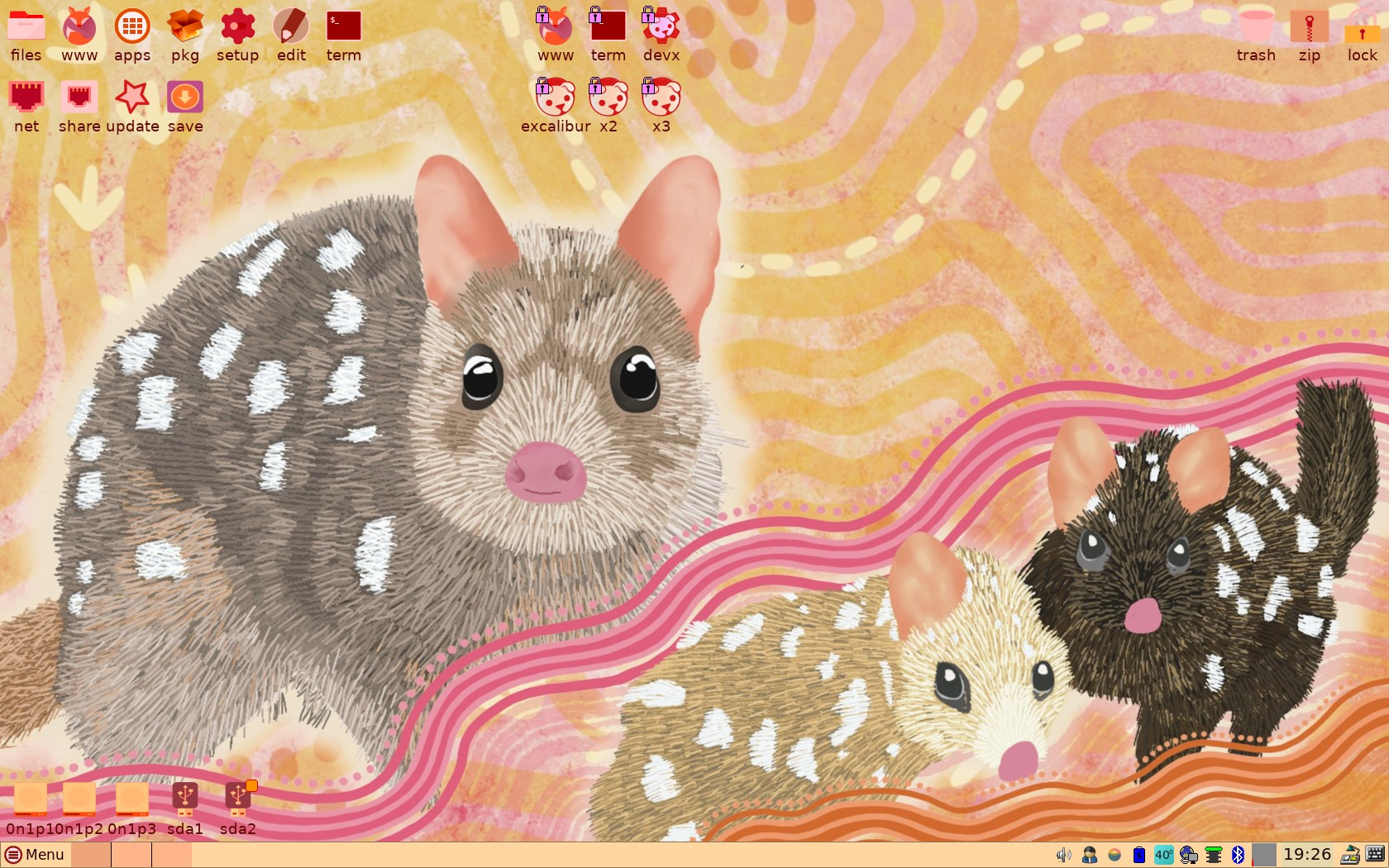
One of EasyOS’s most practical qualities is how much of it is managed through graphical utilities. Packages, desktop settings, networking, and sharing resources over the network can all be controlled through GUI tools, according to the DistroWatch listing. That matters more than it sounds: an experimental distribution could easily be a terminal-only affair, but EasyOS is designed so that trying it does not require editing configuration files.
The default desktop is JWM-ROX, a lightweight combination that keeps resource use low and the interface straightforward — no compositing extravagance, just a working desktop. Chromium and SeaMonkey cover browsing and mail, and the x86_64-only build keeps the focus squarely on standard desktop and laptop hardware. It is a similar minimalism-in-practice to distributions like antiX, another lightweight veteran we have reviewed, though EasyOS takes a very different technical road to get there.
AWS Alternative - Digital Ocean
An Independent, Fixed-Release System with Its Own Init
EasyOS follows a fixed release model with numbered versions rather than rolling updates, and it stays proudly independent: no Debian base, no Ubuntu base, no Arch base. The 7.4 release uses the BusyBox init system and supports the Btrfs and ext4 journaled file systems. Btrfs is a notable inclusion for an experimental distro — its snapshot support pairs naturally with a system designed to be tinkered with and rolled back.
That independence puts EasyOS in the company of other self-standing distributions like Devuan and Void Linux, though its motivations are different: less about init-system philosophy, more about having a clean laboratory bench for container experiments.
Who Should Try EasyOS?
- Linux experimenters and tinkerers who want to play with containerized applications and desktops on a real system, not just read about them.
- Puppy Linux fans following Barry Kauler’s newer project — see our Puppy review for the roots of this family tree.
- USB-boot enthusiasts who want a portable, persistent system on a thumb drive rather than a fixed installation.
- Distro hoppers curious about independent projects that stand outside the Debian/Ubuntu/Arch mainstream.
- Users with modest hardware who want the JWM-ROX desktop’s low footprint with modern package options like Flatpak and DEB.
Final Thoughts
EasyOS 7.4 is not trying to be everyone’s daily driver, and it does not pretend to be. It is an experimental, independent, container-oriented distribution from one of Linux’s most inventive developers — free, live-bootable from USB, and rated a strong 8.8 out of 10 by DistroWatch visitors. If you have ever wished a lightweight distro would take bigger swings, EasyOS is the one taking them.
For release details, package versions, and the full version history, see the EasyOS page at DistroWatch.