Devuan Review
Devuan GNU+Linux 6.1.1 “Excalibur”: Debian, Minus systemd
Devuan GNU+Linux is a Linux distribution forked from Debian in 2015, and its founding sentence on DistroWatch tells the whole story: the project’s primary goal is to provide a variant of Debian “without the complexities and dependencies of systemd,” the init system and services manager originally developed by Red Hat and later adopted by most other Linux distributions. That single design decision — born in the heated debate over systemd’s adoption in Debian Jessie — shapes everything Devuan does, from its three init-system choices to the way it tracks Debian’s releases without surrendering its independence.
The latest stable release listed on DistroWatch is Devuan GNU+Linux 6.1.1, codenamed “Excalibur,” released April 25, 2026. It carries an unusual level of affection from its users: DistroWatch ranks it at 43 with 265 hits per day, and its average visitor rating of 9.0 out of 10 across 182 reader reviews is one of the highest marks of any distribution covered on this site. If you have not read our Debian review, start there — Devuan is built on Debian’s foundations, and understanding what the parent looks like makes the fork’s choices much clearer.
Devuan’s history is part of its identity. Its initial beta arrived in April 2016 with an upgrade path from Debian 7.0 “Wheezy” and the option to switch in place from Debian 8.0 “Jessie” — the release that introduced systemd to Debian. Since then it has followed Debian’s cadence under its own minor-planet codenames: Jessie, ASCII, Beowulf, Chimaera, Daedalus, and now Excalibur. It is free, actively developed, and DistroWatch files it under Desktop, Live Medium, Server, and Raspberry Pi — a range that hints at how many different places a systemd-free Debian can be useful.
Devuan GNU+Linux 6.1.1 at a Glance
| Feature | Devuan GNU+Linux 6.1.1 “Excalibur” |
| Release date | April 25, 2026 (per DistroWatch) |
| OS type | Linux |
| Based on | Debian |
| Origin | Global |
| Desktop | Xfce (default), Cinnamon, KDE Plasma, LXQt, MATE, labwc, Wayfire |
| Architectures | aarch64, armel, armhf, i686, x86_64 |
| Category | Desktop, Live Medium, Server, Raspberry Pi |
| Status | Active |
| Release model | Fixed (stable); Semi-Rolling (testing “Freia”); Rolling (unstable “Ceres”) |
| Installer | Graphical (Debian Installer on earlier releases) |
| Default browser | Chromium, Firefox ESR |
| Package format | deb |
| Package management | apt |
| Init systems | SysV, OpenRC, runit (no systemd) |
| File systems | Btrfs, ext4, JFS, ReiserFS, XFS |
| Price | Free |
| DistroWatch popularity | Rank 43 (265 hits per day) |
| Average visitor rating | 9.0/10 from 182 reviews |
| Previous releases | 5.0.1 “Daedalus” (September 14, 2023), 4.0.0 “Chimaera” (October 14, 2021) |
The Init Choice: SysV, OpenRC, or runit
This is the heart of the distribution. Where Debian and most of its derivatives standardize on systemd, DistroWatch lists Devuan’s init systems as OpenRC, runit, and SysV — and the project treats that choice as a feature, not a footnote. During installation you pick the init system that fits your philosophy and your hardware: SysV init for the classic Unix-style experience, OpenRC for a dependency-based but systemd-independent startup, or runit for something minimal and fast. Nothing in the system assumes systemd is present, and packages with hard systemd dependencies are rebuilt without them.
The result, per the reader reviews on DistroWatch, is a system that feels like Debian in every way that matters — .deb packages, apt, the same enormous software archive, the same familiar administration — with the init layer swapped out for something you can read, audit, and understand. For servers and long-lived installs, that predictability is the whole point: SysV init scripts are just shell, and a decade from now they will still be just shell.
Fixed, Semi-Rolling, or Rolling — Pick Your Tempo
Devuan ships in three flavors that mirror Debian’s branches. The stable release, Excalibur, follows the fixed model: it changes rarely and deliberately, which is what you want on a server or a desktop you do not want to think about. Above it sits “Freia,” the semi-rolling testing branch, and above that “Ceres,” the rolling unstable branch for people who want the newest packages and do not mind the occasional rough edge. The codenames continue Devuan’s tradition of naming releases after minor planets, one step removed from Debian’s Toy Story naming.
That layering makes Devuan more versatile than its quiet reputation suggests. The same project gives you a set-and-forget stable system and a continuously updating testing system, both without systemd, and both installable from the same Debian-style installer. If a fixed release sounds right but systemd is not a dealbreaker either, our MX Linux review covers another Debian-based option with the same Xfce-first sensibility and a different answer to the init question.
Desktops Without the Systemd Strings
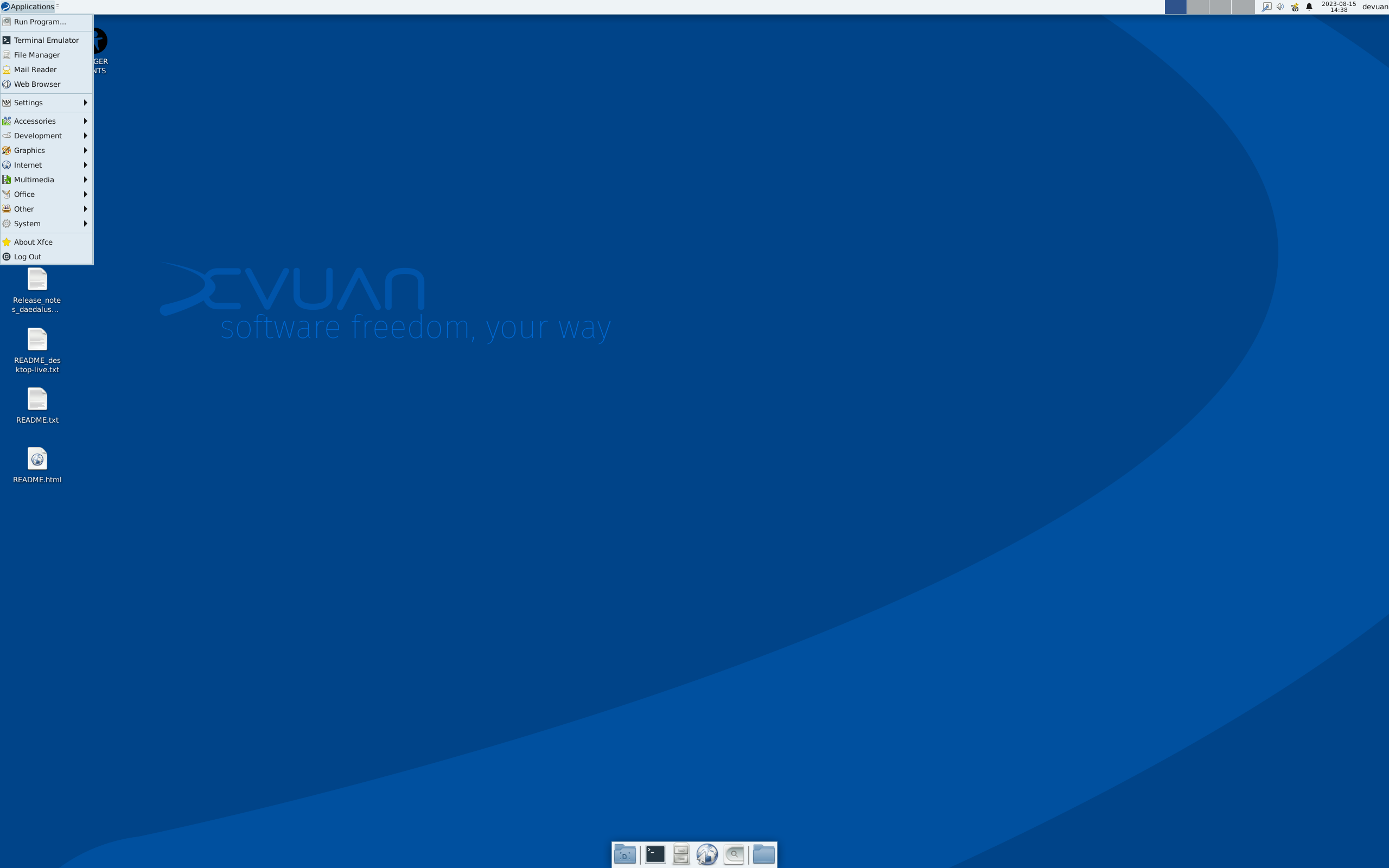
DistroWatch lists seven desktops for the 6.1.1 release — Xfce, Cinnamon, KDE Plasma, LXQt, MATE, labwc, and Wayfire — with Xfce as the default, the same choice Devuan made at its very first beta. That is a telling combination: a lightweight, classic desktop on a system whose whole pitch is simplicity and transparency. The heavier options are there too — KDE Plasma and Cinnamon ship complete — which matters because several mainstream desktops have drifted toward systemd dependencies over the years. Devuan’s packaging keeps them working without it.
AWS Alternative - Digital Ocean
The inclusion of labwc and Wayfire alongside the classics is a quiet statement that this is not a nostalgia project. Devuan runs modern Wayland compositors; it just boots them with runit or OpenRC instead of systemd. Readers of our Artix review will recognize the philosophy — init freedom as a design principle — applied here to the Debian universe instead of the Arch one.
Broad Hardware Reach
Devuan’s architecture list is unusually wide: aarch64, armel, armhf, i686, and x86_64. That matters for the Raspberry Pi crowd — the listing carries the Raspberry Pi category — and for anyone keeping genuinely old hardware useful, where the i686 and ARM builds pair naturally with a light init system and Xfce. The Live Medium category means you can try it from a USB stick before committing, and the Server category is where Devuan arguably shines brightest: a Debian-stable base with a legible init system is a compelling combination for machines you administer remotely for years.
Get The Polymarket App - Get $50
For an even lighter, antiX-style take on the systemd-free Debian family aimed at aging hardware, our antiX review covers a close cousin with the same lineage and a smaller footprint.
Who Should Try Devuan GNU+Linux?
- System administrators who want Debian’s stability and packaging with an init system they can audit line by line.
- Long-time Linux users who followed the systemd debate and want a distribution that treats init freedom as a founding principle.
- Server operators building long-lived installs where SysV init or runit scripts are easier to reason about than unit files.
- Raspberry Pi and ARM tinkerers who want a full Debian-family system on small boards, live-bootable from USB.
- Users reviving older hardware who want a modern, maintained system without systemd’s resource overhead.
- Debian fans who are perfectly happy with systemd — our Linux Mint review covers the friendliest corner of the Debian family.
Final Thoughts
Devuan GNU+Linux 6.1.1 “Excalibur” is a decade-old bet that still looks prescient: that a meaningful number of people want everything Debian offers except systemd, and that a distribution built around that single conviction can be complete, modern, and genuinely pleasant to run. The 9.0/10 visitor rating across 182 DistroWatch reviews suggests the bet paid off — this is one of the best-loved distributions in its tier, precisely because it knows exactly what it is.
If systemd’s design bothers you — or if you simply want to see how the Debian world looks without it — Devuan is the most complete answer available. Start with the stable Excalibur release, try it live, and pick your init system at install time. The Debian, MX Linux, antiX, and Artix reviews linked above cover the neighboring philosophies if you want to compare.
For release details, version history, and reader reviews, see the Devuan GNU+Linux page at DistroWatch.