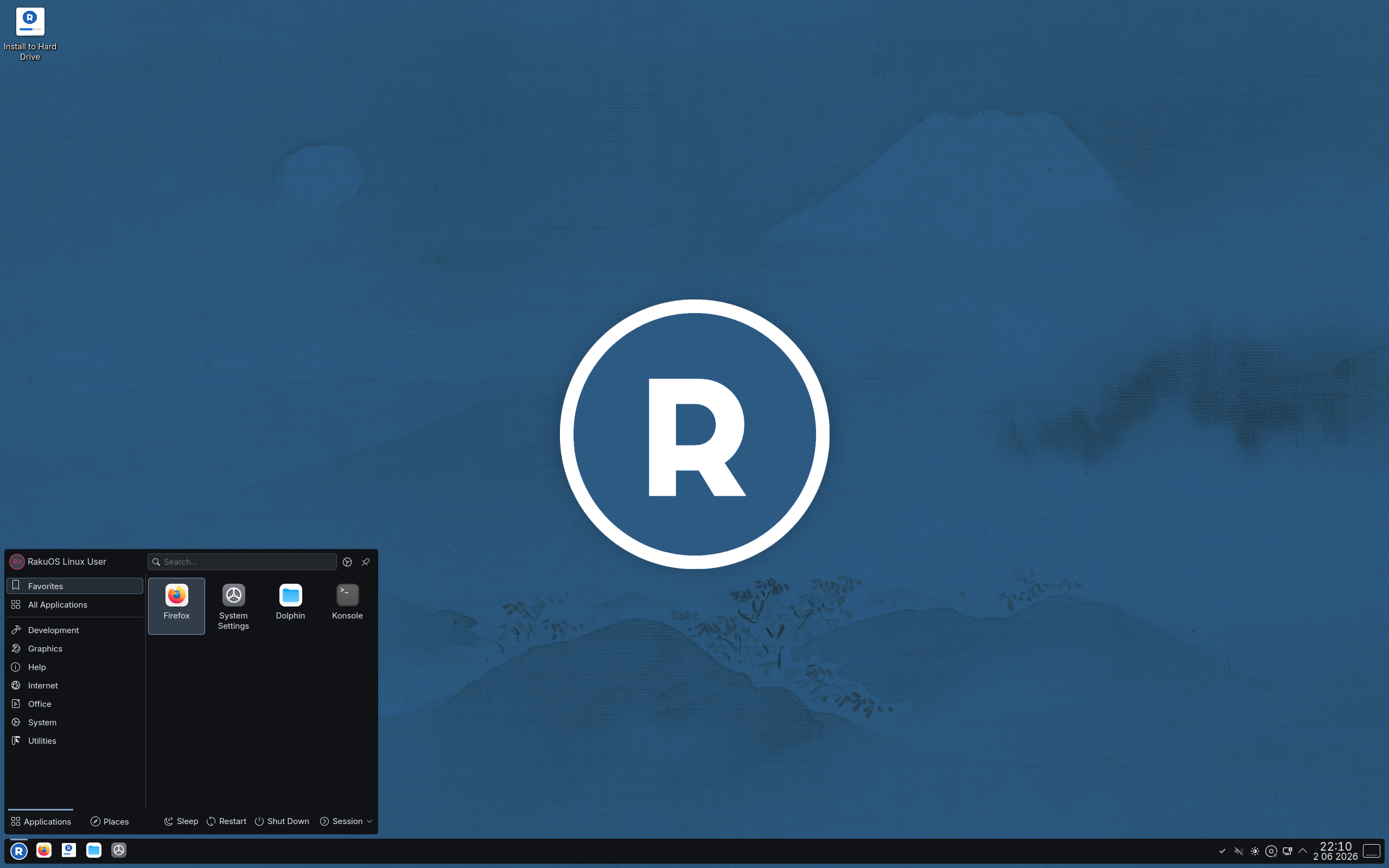
RakuOS Review
RakuOS 2026.05.16: Immutable Fedora, Four Desktops, and a Gamer’s Heart
Immutable Linux is having a moment, but most takes on it ask you to give something up: native packages, your favorite desktop, or the freedom to tinker. RakuOS says you can keep all three — a read-only Fedora base that updates atomically, a persistent overlay that runs dnf like a traditional system, and a choice of KDE Plasma, GNOME, COSMIC, or niri.
According to the RakuOS listing on DistroWatch, the distribution is an immutable Linux distribution based on Fedora, and its current listed release is 2026.05.16, released May 16, 2026. It is built for 64-bit x86 systems, carries the Desktop, Gaming, and Immutable categories, and its status is listed as Active. If you want the upstream context first, our Fedora review covers the base RakuOS builds on.
The pitch is deliberately aimed at a tension in the immutable-desktop world. Read-only systems are great at surviving bad updates, but they can feel sealed off from the way many of us actually use Linux. RakuOS combines an immutable, read-only base with what DistroWatch describes as the full package flexibility of a traditional distribution: while the core updates atomically and can be instantly rolled back, a persistent overlay lets you install any package through dnf or through the distribution’s own RakuOS Software center. Flatpak installation is supported too.
At a Glance
| Distribution family | Fedora-based, immutable |
| Current listed release | 2026.05.16, released May 16, 2026 |
| Desktop choices | KDE Plasma, GNOME, COSMIC, niri |
| Architecture | x86_64 |
| Package management | dnf, RakuOS Software center, Flatpak support |
| Update model | Atomic updates of the read-only base, with instant rollback |
| Categories listed | Desktop, Gaming, Immutable |
| DistroWatch popularity | Rank 47 (6-month average, 251 hits per day) |
| Visitor rating | 9.5/10 from 14 reviews |
Feature details and version information are based on the DistroWatch RakuOS listing for release 2026.05.16.
Immutable, but Not Locked Down
The core idea is simple to state and hard to get right: the base system is read-only, so it cannot be broken by a stray command or a failed update, and every update applies atomically. If something does go wrong, the system can be instantly rolled back. That is the same promise that draws people to immutable options like Vanilla OS — but RakuOS pairs it with an escape valve the listing emphasizes.
Instead of forcing everything through containers or layered images, RakuOS keeps a persistent overlay where you can install any package with dnf, exactly the workflow Fedora users already know, or browse the graphical RakuOS Software center. Flatpak packages are supported alongside. In practice, that means the immutability protects the foundation while the day-to-day software experience feels like a conventional distro — a design meant to make the transition painless for users who have never touched an immutable system before.
Immutability is only as good as the rollback story. RakuOS’s instant rollback is what turns “read-only” from a restriction into a safety net: you can experiment freely precisely because the base image can be restored in moments.
Four Desktops, One Read-Only Core
Most immutable distributions ship one desktop and ask you to adapt. The DistroWatch listing gives RakuOS a choice of KDE Plasma, GNOME, niri, and COSMIC. That lineup covers a lot of ground: Plasma for the configurability-first crowd, GNOME for a clean, opinionated workflow, COSMIC for those following System76’s Rust-based desktop, and niri for tiling-window-manager devotees.
Offering four desktops on an immutable base is a statement of intent. It says the project sees immutability as a reliability feature, not a lifestyle — you still get to pick the interface you actually want to live in, and the atomic-update machinery works the same underneath whichever you choose.
Try YouTube TV | Special Discount
Built With Gamers in Mind
The listing puts RakuOS in the Gaming category, and the details back that up. The distribution uses what DistroWatch describes as a performance-optimised p03 Linux kernel, and it ships a graphical CPU scheduling utility that lets you fine-tune the system for gaming, heavy workloads, or power-efficiency use cases.
That combination — a tuned kernel plus one-click scheduler profiles — is clearly aimed at the same audience that made Bazzite, another Fedora-based immutable gaming distro, popular. The difference is the overlay: on RakuOS, installing a game or tool that isn’t a Flatpak can be a plain dnf command on the persistent overlay rather than a trip through container tooling.
An Active Project on the Rise
The DistroWatch numbers suggest RakuOS is a young project gathering momentum. Its 6-month popularity rank sits at 47 (251 hits per day), a climb from 102 over 12 months — and the most recent rankings show it edging higher still, with a 4-week rank of 33. Visitors rate it 9.5 out of 10 across 14 reviews, which is an unusually warm reception for a relatively new listing.
Recent news adds intrigue: a June 2026 DistroWatch headline reports that Origami Linux is merging with RakuOS. Consolidation like that can be a sign of a project finding its footing — more hands, more users, more momentum. Worth watching how that shapes the next releases.
Free Credit Score Monitoring At Sofi
The version scheme is worth noting too: releases are stamped by date (2026.05.16, preceded by 2026.04.15), so you can read freshness straight off the release name. The listing does not name a release model, init system, filesystems, or price — check the project’s own documentation at rakuos.org for those details.
Who Should Try RakuOS?
RakuOS is especially interesting for users who like the safety of an immutable system but refuse to give up the flexibility of a traditional one.
- Gamers who want a Fedora-based immutable desktop with a performance-tuned kernel and a graphical CPU scheduler.
- Tinkerers who like atomic updates and instant rollback but still want dnf and native packages on a persistent overlay.
- Desktop explorers who want KDE Plasma, GNOME, COSMIC, or the niri tiling compositor on the same immutable foundation — no reinstallation gymnastics required.
- Immutable-curious users who bounced off more locked-down options; RakuOS’s overlay-plus-software-center approach, much like Nobara’s gamer-friendly take on Fedora, keeps the learning curve gentle.
- Early adopters who enjoy following a fast-climbing project — the 9.5/10 visitor rating and rising rank suggest this one is worth watching.
On the other hand, RakuOS may not suit users who want a long-established, conservative system with years of release history to judge by, or those who prefer their immutability to come from a major vendor’s ecosystem. The listing’s origin is simply “Unknown,” and this is still a young project.
Final Thoughts
RakuOS occupies an appealing middle ground in the Linux world: the reliability story of an immutable, atomically updated, instantly roll-backable Fedora base, combined with the freedom to install anything via dnf, RakuOS Software, or Flatpak on a persistent overlay.
Its DistroWatch profile paints a clear picture: four desktop choices, a performance-tuned kernel aimed at gamers, a rising popularity rank, and a 9.5/10 rating from early visitors. With the Origami Linux merger now part of the story, the project has momentum. If you have been curious about immutable desktops but held back because they felt too restrictive, RakuOS 2026.05.16 is worth putting on the test-drive list.
Bottom line: RakuOS keeps the safety net of immutability without taking away the toys — dnf, your desktop of choice, and a kernel tuned for play.
Source: DistroWatch: RakuOS feature and package table. Information cited in this post reflects the DistroWatch listing for RakuOS release 2026.05.16, dated May 16, 2026.