OmegaLinux Review
OmegaLinux 2026.08.21: Arch Rolling Power for 1 GB Machines
Most lightweight distributions compromise: they stay small by staying static, freezing an old software base so your aging hardware never chokes. OmegaLinux takes the opposite bet. It is an Arch-based, rolling-release Linux distribution, according to its DistroWatch listing, which means it keeps the software stream flowing — and it delivers all of that inside the lean LXDE desktop, a combination DistroWatch says is suitable for installation on older computers with as little as 1 GB of memory.
OmegaLinux hails from Chile, and it carries an interesting origin story. The distribution was originally based on Lubuntu, but it was rebuilt on top of an Arch Linux base in February 2026. That rebuild is more than a footnote: it changed the entire character of the project, from an Ubuntu-family derivative to a rolling Arch-family system with pacman package management — while keeping the lightweight-desktop mission intact.
DistroWatch lists OmegaLinux’s base as Arch, Debian, and Ubuntu (LTS), reflecting that hybrid heritage, and files it under the Desktop, Live Medium, and Old Computers categories. The latest release on the listing is 2026.08.21, released August 21, 2026. A rolling-release distro aimed at machines other distros leave behind is a genuinely unusual combination — worth a closer look.
OmegaLinux at a Glance
| Latest release | OmegaLinux 2026.08.21 (August 21, 2026) |
| Based on | Arch, Debian, Ubuntu (LTS) — rebuilt on an Arch base in February 2026 after starting out Lubuntu-based |
| Origin | Chile |
| Status | Active |
| Cost | Free |
| Installation | Calamares; ISO image 1,800–1,900 MB, free download |
| Default desktop / browser | LXDE / Firefox |
| Release model | Rolling |
| Package format / management | pkg / pacman |
| Architectures | x86_64 |
| Init / filesystems | systemd / Btrfs, ext4, JFS, XFS |
| DistroWatch popularity rank | 93 (155 hits per day) |
| DistroWatch visitor rating | 8.5/10 from 2 reviews |
Table note: All facts in this review are taken from OmegaLinux’s listing at DistroWatch. Release details refer to version 2026.08.21, released August 21, 2026.
From Lubuntu to Arch: A Rebuild That Changed Everything
The most important thing to understand about OmegaLinux is the pivot. The project began life on a Lubuntu foundation, which made it a light, Ubuntu-family derivative in a crowded field — alongside well-known Debian-family lightweight options like MX Linux, reviewed here. In February 2026, the developers rebuilt it on top of Arch Linux instead.
That single decision reframes the whole distribution. The Ubuntu lineage survives in the project’s habits and packaging instincts, and DistroWatch still lists Debian and Ubuntu (LTS) among its bases — but the machinery underneath is now Arch-style: a rolling release model and pacman as the package manager, with the pkg package format. For users, that means no version upgrades to dread and no big-bang reinstalls every couple of years; the system simply stays current.
Rolling Software, Old Hardware
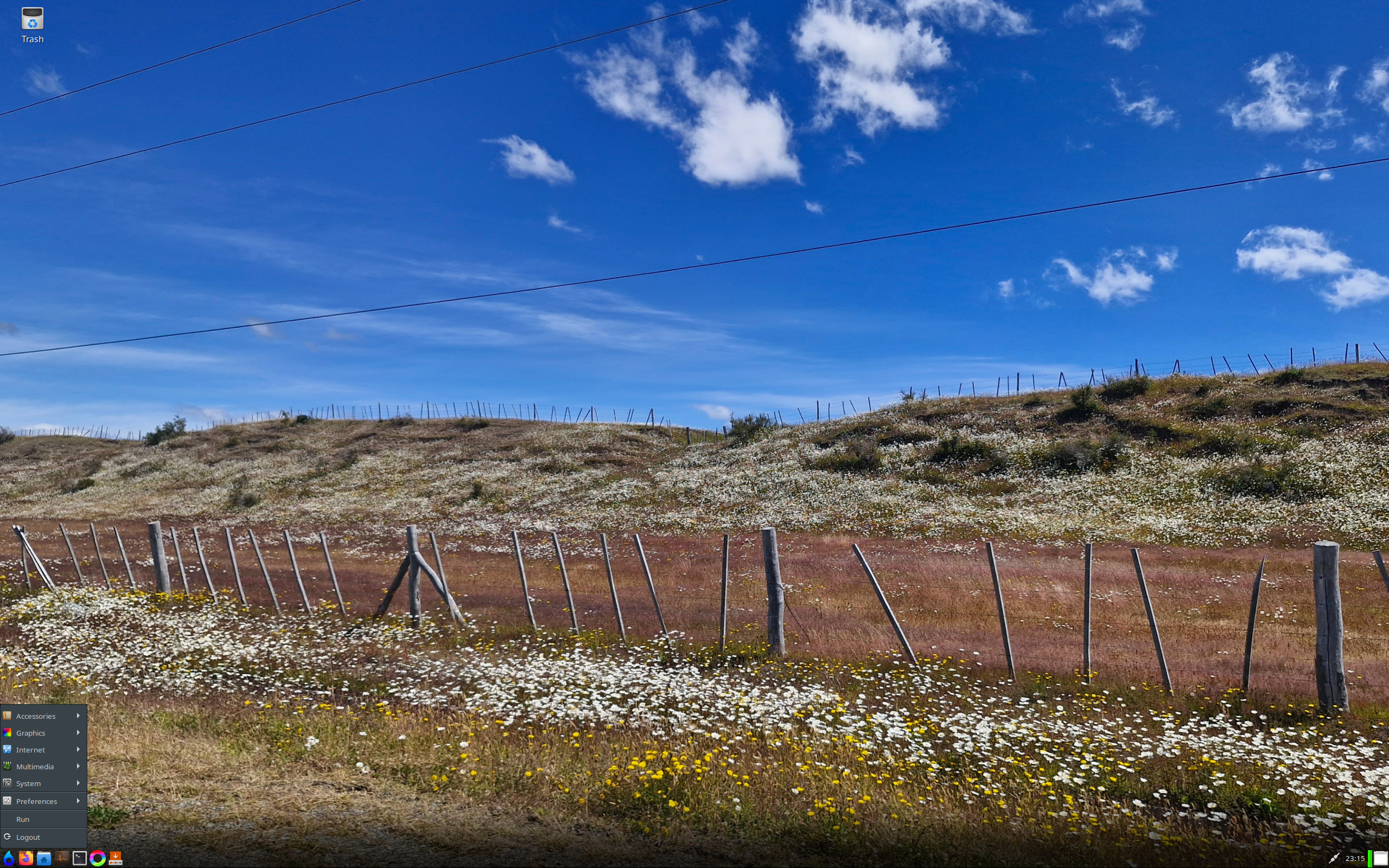
Here is where OmegaLinux gets genuinely interesting. Rolling-release distributions are usually performance-hungry — think of the heavyweight Arch-based experiences covered in our CachyOS review. OmegaLinux instead bolts the rolling model onto LXDE, one of the lightest mainstream desktop environments ever shipped, and targets machines with as little as 1 GB of RAM.
The Calamares installer handles setup — the same friendly graphical installer used by many approachable distributions — and the live ISO (listed at 1,800–1,900 MB) lets you test-drive the environment before committing. The x86_64-only build keeps things simple, systemd handles init, and the filesystem menu covers Btrfs, ext4, JFS, and XFS. Nothing here is exotic; the exotic part is the combination.
What’s Inside the 2026.08.21 ISO
DistroWatch’s package table for the 2026.08.21 release shows software that is anything but geriatric. The kernel is Linux 7.2.9, systemd sits at version 262, and the default browser, Firefox, is at 157.0.1. LibreOffice 26.8.1, Python 3.15.0, and GCC 16.2.0 round out a stack that looks thoroughly modern — proof that “old computers” and “old software” do not have to go together.
The 1.8–1.9 GB image size is worth noting: this is not a minimal LXDE install. That ISO carries a full desktop, a browser, and an office suite, so the lightness comes from the desktop environment and the rolling base, not from stripping the system to the bone. Downloads are hosted on the project’s GitHub releases page and through the DistroWatch Torrent Archive, with a bug tracker on GitHub for issue reports.
Refinance Your Student Loan At Sofi
A Small Project with a Steady Audience
DistroWatch places OmegaLinux at popularity rank 93, drawing 155 hits per day — modest numbers, but the trend is worth reading. The 3-month rank of 66 (180 hits per day) and recent 4-week and 1-week figures of 143 and 147 show the project’s visibility spiking around its August release and the rebuild story gaining attention. The average visitor rating of 8.5/10 from two reviews is a small sample, but it is a warm one.
Small, regionally rooted projects like this one live or die on momentum, and the Chile-based team has kept the listing’s status Active with a real release cadence — 2026.08.21 follows the earlier 3.5 release. For a distribution that essentially reinvented itself mid-year, steady output is the signal to watch.
Get An Easy Personal Loan At Sofi
Who Should Try OmegaLinux?
- Owners of aging laptops. If you have a machine with 1–2 GB of RAM that modern desktops have left behind, the LXDE-plus-rolling combination gives it current software instead of a frozen museum install.
- Arch-curious beginners. A rolling release with a friendly Calamares installer and pacman underneath is a gentler entry point than vanilla Arch — though our EndeavourOS review covers another well-trodden path into the Arch world.
- Lightweight-desktop fans. If you prefer LXDE’s no-nonsense panels and menus to the heavier modern desktops, this is one of the few rolling options built around it.
- Tinkerers who enjoy small projects. Following a regional distribution through its rebuild era is its own kind of fun, and the GitHub-hosted development is out in the open.
Who should skip it? Anyone who wants a point-and-release system with long-term stability guarantees — a rolling model is the opposite of “install and ignore for five years.” And if your hardware is truly ancient (think sub-gigabyte territory), an even leaner specialist like the one in our antiX review may be a better fit than a 1.8 GB ISO.
Final Thoughts
OmegaLinux is one of the more conceptually daring distributions in DistroWatch’s lightweight corner: it asks whether old hardware deserves rolling software, and answers with a resounding yes. The February 2026 rebuild on Arch gave the project a distinctive identity — LXDE lightness, pacman freshness, Calamares ease — at a time when most light distributions were playing it safe on frozen bases.
It is still a small project, and the 2026.08.21 release is the one to judge it by: current kernel, current browser, a full desktop in under 2 GB, aimed at machines other distros consider obsolete. If you have one of those machines gathering dust, OmegaLinux 2026.08.21 might be the most interesting thing you can put on it this year.
Source: the DistroWatch OmegaLinux listing, covering release 2026.08.21 (August 21, 2026).