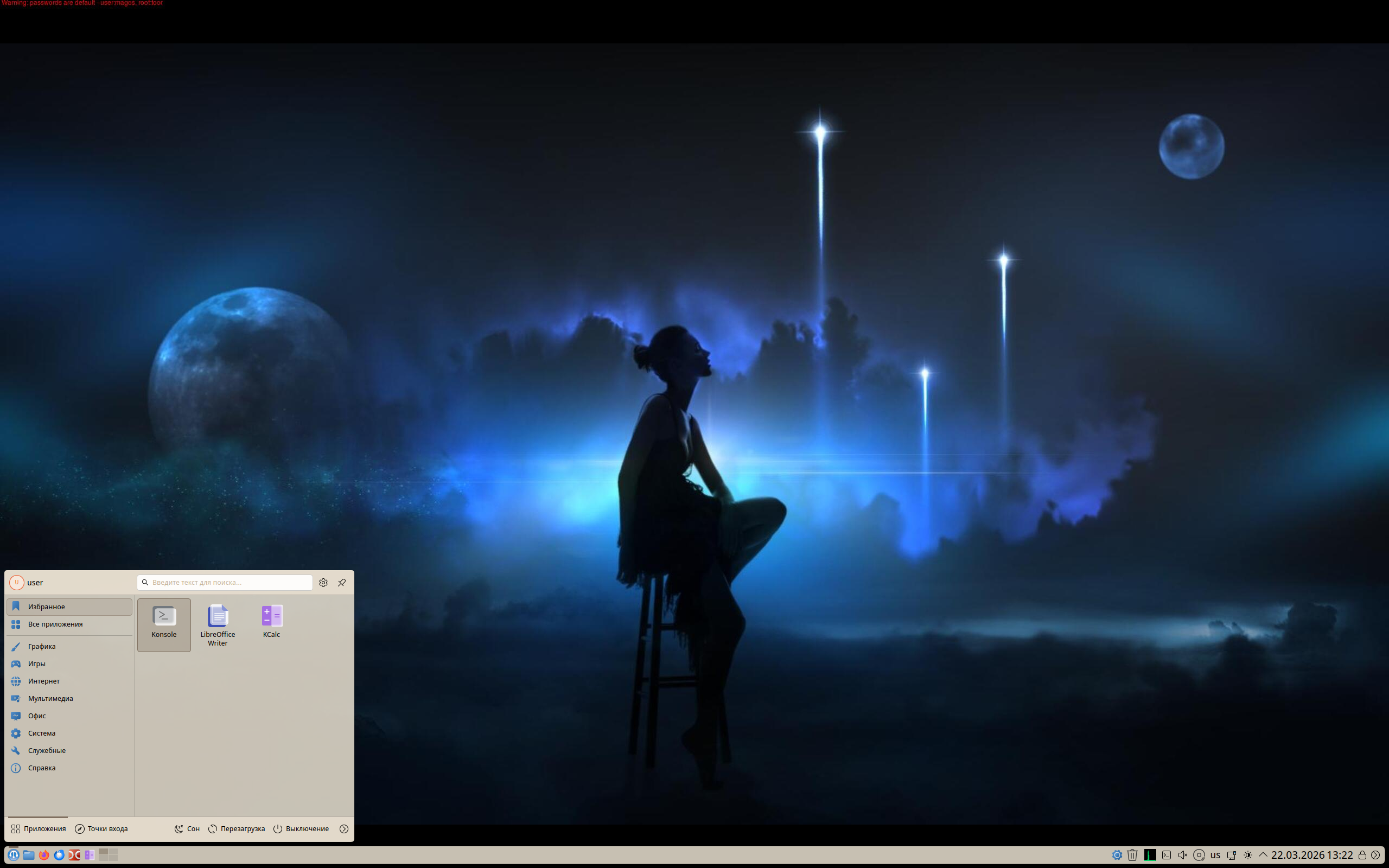
MagOS Review
MagOS Linux 2025_20260925: A ROSA-Based Desktop That Adds Its Own Drivers, Modules and Desktops
MagOS Linux does not start from scratch. According to its DistroWatch listing, it is a Russian desktop-oriented distribution based on ROSA, a distribution that was forked from Mandriva Linux in 2011. From that RPM foundation, MagOS builds a ready-to-use desktop — and then adds its own package repository and a modular extra layer on top.
The latest release in DistroWatch’s feature table is MagOS Linux 2025_20260925, released on 25 September 2026. It is free, listed as Active, and categorised by DistroWatch as a Desktop and Live Medium system for x86_64 hardware. It sits at number 96 in DistroWatch’s popularity rankings with 151 hits per day, and visitors rate it 10.0 out of 10 from 1 review — a perfect score, but from a very small sample, so it says more about one happy user than about broad consensus.
That Mandriva lineage will feel familiar to anyone who has read our Mageia review: Mageia is the other well-known continuation of the Mandriva family tree. MagOS takes a different branch through ROSA, with KDE Plasma by default and a lighter option kept in reserve for older hardware.
At a Glance
| Latest Release | 2025_20260925 (25 September 2026) |
| OS Type | Linux |
| Base | ROSA |
| Origin | Russia |
| Desktop | KDE Plasma (default), LXQt |
| Architectures | x86_64 |
| Installer | Graphical |
| Package Management | dnf — rpm package format |
| Release Model | Fixed |
| Init System | systemd |
| File Systems | Btrfs, JFS, ext4, ReiserFS, XFS (journaled) |
| Default Browser | Firefox |
| Office Suite | LibreOffice |
| Price | Free (ISO image size approx. 3,400–3,500 MB for 2025_20260925) |
| DistroWatch Popularity | 96 (151 hits per day) |
| Visitor Rating | 10.0/10 from 1 review |
Two Desktops: Plasma for Power, LXQt for Older PCs
DistroWatch says MagOS comes with the KDE Plasma desktop by default, but also ships the lightweight LXQt desktop for older and low-specification computers. That two-track choice is built into the feature table as well, which lists the default desktop as KDE Plasma and LXQt for 2025_20260925 and for the earlier releases shown alongside it.
US Mobile | Plans As Low As $10, Get $30 Instantly
Plasma puts MagOS in the same conversation as our Kubuntu review, where Plasma sits on an Ubuntu base with deb packages underneath. Here the same polished, configurable desktop sits instead on ROSA and RPM packages managed with dnf. If you like Plasma’s way of working but prefer the RPM world, MagOS is offering exactly that combination — with LXQt as an escape hatch when the hardware is too modest for Plasma.
The Modular Extra Layer in XZM Format
The most distinctive part of MagOS, on DistroWatch’s evidence, is what it adds beyond ROSA’s standard upstream packages. The listing says the project provides its own RPM package repository, with various network and NVIDIA display drivers, as well as separate modules in XZM format with extra hardware drivers, server tools, the MATE desktop, the Wine emulator, Java software and additional web browsers, including Chromium and Yandex.
That modular idea matters because it keeps the base image focused — a 3,400–3,500 MB free ISO download, per DistroWatch — while making whole bundles of extra capability available as add-ons rather than forcing every user to install them. Need Wine, Java or a different browser? On DistroWatch’s description, that is a module, not a rebuild. The default browser remains Firefox and the office suite LibreOffice, so the out-of-the-box system is conventional; the modules are where MagOS gets opinionated.
ROSA and RPM Underneath, dnf in Front
Under the desktops and modules, the mechanics are firmly in the RPM tradition. DistroWatch lists the package format as rpm and, for 2025_20260925, package management as dnf — a change from the oldest release in the table, 2016_20220625, which listed rpmdrake. Installation is graphical, the release model is Fixed, init is systemd, and journaled file systems are listed as Btrfs, JFS, ext4, ReiserFS and XFS. The listing records the system as multilingual in Russian (ru).
Readers who know the RPM mainstream will recognise that dnf workflow from our Fedora review, even though Fedora and MagOS come from very different branches of the Linux world. Another useful comparison from the Mandriva side of the family is our PCLinuxOS review — a fellow Mandriva descendant that, like MagOS, has kept its own distinct character rather than simply tracking its parent.
Refinance Your Student Loan At Sofi
Who Should Try MagOS Linux?
- ROSA and Mandriva-family users — DistroWatch lists the base as ROSA, forked from Mandriva Linux in 2011; compare the sibling lineage in Mageia’s take on that heritage.
- KDE Plasma fans in the RPM world — Plasma is the default desktop, with rpm packages and dnf underneath, per DistroWatch.
- Owners of older or low-spec PCs — DistroWatch says the LXQt edition is shipped specifically for older and low-specification computers, and the system is also a Live Medium you can test first.
- Users who need extra drivers without hunting — the project’s own RPM repository provides various network and NVIDIA display drivers, per DistroWatch, alongside XZM modules for further hardware drivers.
- Tinkerers who like modular add-ons — XZM modules add server tools, MATE, Wine, Java and extra browsers including Chromium and Yandex, per DistroWatch, without bloating the base system.
Final Thoughts
MagOS Linux 2025_20260925 is a ROSA-based desktop with a clear division of labour: KDE Plasma (or LXQt on weaker hardware) on top, RPM packages managed by dnf, systemd underneath, Firefox and LibreOffice as defaults, and then MagOS’s own repository and XZM modules for the drivers and extras ROSA alone does not supply. Its rank of 96 and a 10.0/10 rating from just 1 review mark it as a niche, largely Russian-language project — DistroWatch lists its multilingual support as ru — rather than a mainstream contender.
If your roots are in the Mandriva and ROSA world, or you simply want Plasma on an RPM base with a modular way to add Wine, Java, MATE or extra drivers, MagOS is worth a live test from its 3,400–3,500 MB image. Just go in expecting a small project’s documentation and community — its home page and forums are at magos-linux.ru, per DistroWatch — rather than the scale of Fedora or Mageia.
Source: DistroWatch’s MagOS Linux listing, covering the MagOS Linux 2025_20260925 release of 25 September 2026.