Liya Review
Liya Linux 2026.08.29: Arch’s Rolling Edge in a Calm Cinnamon Package
Liya Linux wants to be the contradiction that Arch fans keep asking for: a distribution built on Arch Linux’s rolling release model, but designed, in DistroWatch’s words, “to be easy to use, easy to explore and distraction-free.” The project’s DistroWatch listing describes an Arch-based rolling release that ships with the Calamares system installer, the Cinnamon desktop environment, the Pamac graphical package manager, and OnlyOffice — a combination that reads like a checklist aimed squarely at people who like Arch’s software but not its homework.
The release under review is Liya Linux 2026.08.29, announced August 29, 2026 per DistroWatch. The version history shows a project still finding its naming stride — it was formerly listed simply as “Liya” — and picking up pace: 2.5.1 on February 2, 2026 and 2.5 on January 24, 2026, after 2.4 in July 2025, 1.0 in May 2024, and 7.1 back in June 2023. The 2026 releases in particular suggest development is accelerating. If you have followed the Arch-family reviews on this site, Liya sits in interesting company: our EndeavourOS review covers the other prominent “friendly Arch” rolling release, while our Manjaro review looks at the granddaddy of the approachable-Arch idea — and the project Pamac, Liya’s graphical package manager, originally grew up on.
DistroWatch currently ranks Liya at 223 with 68 hits per day, and its visitors rate it 7.6 out of 10 across 12 reviews — modest numbers for a young distribution, but respectable for one that has only been on the radar in its current form for a few years. The audience is easy to picture: users who want Cinnamon’s familiar, traditional desktop, Arch’s fresh software, and an installer that does not require reading a wiki page first.
Liya Linux 2026.08.29 at a Glance
| Feature | Liya Linux 2026.08.29 |
| Release date | August 29, 2026 (per DistroWatch) |
| OS type | Linux |
| Based on | Arch |
| Origin | Global |
| Desktop | Cinnamon (6.6.9) |
| Architectures | x86_64 |
| Category | Desktop, Live Medium |
| Status | Active |
| Release model | Rolling |
| Installer | Calamares (graphical) |
| Package management | pacman |
| Package formats | pkg, Flatpak |
| Graphical package manager | Pamac |
| Default browser | Brave |
| Office suite | OnlyOffice |
| Kernel | 7.2.9 |
| Init system | systemd |
| File systems | Btrfs, ext4, JFS, XFS |
| Image size | 4,400–4,500 MB (ISO) |
| Multilingual | Yes |
| Price | Free |
| DistroWatch popularity | Rank 223 (68 hits per day) |
| Average visitor rating | 7.6/10 from 12 reviews |
| Previous releases | 2.5.1 (February 2, 2026), 2.5 (January 24, 2026), 2.4 (July 23, 2025), 1.0 (May 16, 2024) |
Rolling Arch, Minus the Command-Line Gauntlet
The defining choice Liya makes is its release model: fully rolling, inheriting Arch’s continuous-update flow. DistroWatch lists the kernel at 7.2.9 in the 2026.08.29 snapshot — the kind of freshness that point-release distributions deliver only at their scheduled intervals. Pacman is the underlying package manager, and the listing shows support for both the native pkg format and Flatpak, so the software story is the Arch one: an enormous repository plus the cross-distribution Flatpak catalog for anything missing.
Where Liya diverges from raw Arch is the access layer. Pamac — the graphical package manager best known from Manjaro, which we reviewed here — sits on top of pacman for point-and-click installs, updates, and browsing. That pairing (rolling Arch underneath, a friendly GUI on top) is the same pitch EndeavourOS makes, but Liya couples it with a different desktop and a stronger “distraction-free” positioning, which is where the comparison gets interesting rather than redundant.
Cinnamon, Tuned for Calm
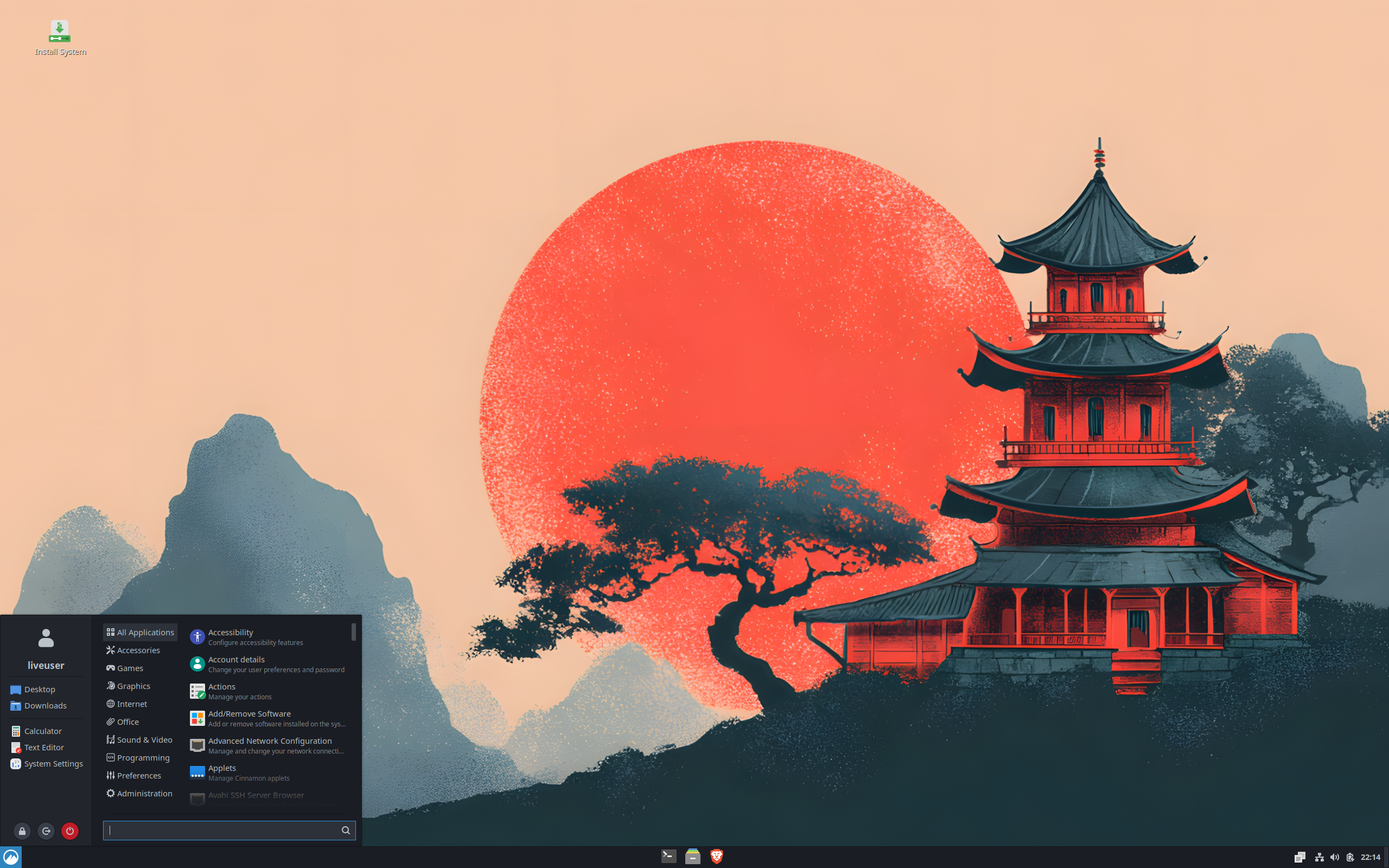
The default desktop is Cinnamon 6.6.9, and it is hard not to read that as a deliberate statement of intent. Cinnamon is the traditional taskbar-and-menu desktop that Mint made famous — if you have not seen it, our Linux Mint review covers the desktop’s home turf in detail — and Liya’s “distraction-free” goal maps neatly onto what Cinnamon does best: stay out of the way, keep the workflow familiar, and let windows and workspaces do the talking.
The default application choices reinforce the theme. OnlyOffice ships as the office suite rather than the heavier LibreOffice, Brave is the default browser instead of Firefox or Chromium, and the whole thing is multilingual out of the box. None of these are dramatic choices individually, but together they sketch a distribution that has opinions about what a desktop should feel like: quiet, current, and immediately usable.
Calamares, Live Boot, and the Practical Details
Installation is handled by Calamares, the graphical installer used by a long list of friendly distributions. DistroWatch files Liya under the Live Medium category, so you can boot the 4.4–4.5 GB ISO, try the full Cinnamon desktop, check your Wi-Fi and graphics, and only then commit to an install. For an Arch-based system — a family historically associated with text-mode installs — that low-friction entry point is arguably Liya’s whole reason to exist.
Underneath, the plumbing is standard modern Linux: systemd as the init system, with Btrfs, ext4, JFS, and XFS as the listed journaled filesystems, on 64-bit x86 hardware. The price is free, the download is a plain ISO, and the project supports its users through forums, Discord, and Telegram channels plus wiki documentation. For a small project, that support footprint matters — rolling-release systems generate questions, and having somewhere to ask them is part of the product.
A Young Project Picking Up Speed
The release history is the most telling thing on Liya’s DistroWatch page. After 7.1 in 2023 and 1.0 in 2024 — version numbers that suggest an early, experimental era — the project shipped 2.4 in mid-2025 and then three releases in the first eight months of 2026. The rebrand from “Liya” to “Liya Linux” happened somewhere along the way, another small sign of a project deciding what it wants to be when it grows up.
DistroWatch also links reviews of the 2.x series from its own review team and from N4Si, which gives prospective users independent impressions to consult before downloading. At rank 223 with a 7.6/10 visitor rating, Liya is not threatening the top of the charts — but for a distribution this young, in the crowded Arch-derivative space alongside heavyweights like CachyOS, which we reviewed here, steady upward motion in both release cadence and visibility is exactly what you want to see.
Who Should Try Liya?
- Arch-curious users who want rolling-release software freshness without Arch’s manual installation and configuration.
- Cinnamon fans looking for the traditional desktop on a rolling base instead of a fixed-release one — our Linux Mint review covers the fixed-release side of that choice.
- Pamac users coming from Manjaro who want the same graphical package workflow on a purer rolling Arch foundation.
- Anyone who values a “distraction-free” desktop: OnlyOffice, Brave, and a calm Cinnamon setup with minimal fuss.
- Multilingual households or international users, since the ISO ships with multilingual support out of the box.
- Distro hoppers who enjoy watching young projects evolve — Liya’s 2026 release pace makes it an interesting one to track.
Final Thoughts
Liya Linux 2026.08.29 is a young distribution with a clear thesis: take Arch’s rolling release model and pacman software universe, and wrap them in the calmest possible Cinnamon desktop with a graphical installer and a friendly package manager. It does not have the performance-tuning identity of CachyOS or the community scale of Manjaro and EndeavourOS, but it does not need them — its pitch is serenity, not speed records. The 7.6/10 visitor rating and the quickening release cadence suggest the formula is finding its audience.
If the rolling model appeals but you want a different flavor of friendly Arch, read our EndeavourOS review; if Cinnamon on a fixed release sounds better, see our Linux Mint review. But if you want Arch that boots into a quiet, familiar desktop and stays current without drama, Liya Linux is worth a download.
For release announcements, version history, package lists, and reader reviews, see the Liya Linux page at DistroWatch.