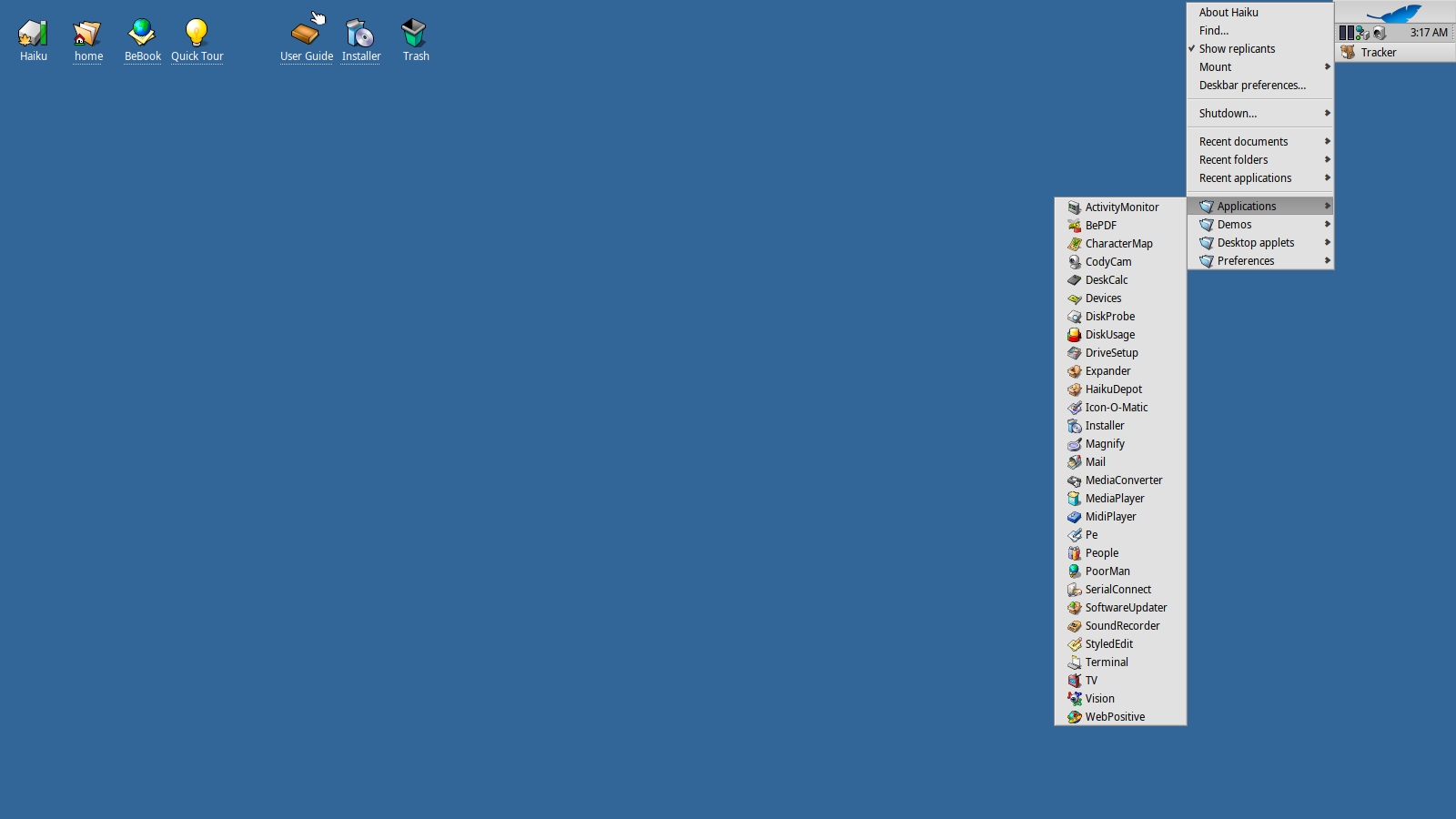
Haiku Review
Haiku R1 Beta 6: The BeOS-Inspired Outsider
An independent, open-source operating system inspired by BeOS — a custom kernel built for responsiveness, a fully threaded design, an object-oriented API, and the database-like BFS file system, now at development release R1 Beta 6.
Let’s clear something up first: Haiku is not a Linux distribution at all. Its DistroWatch listing files it under OS Type “Other OS,” and its “Based on” field reads simply “Independent.” It sits in the same small corner of the tables as projects like ReactOS, the Windows-compatible upstart — operating systems written from scratch rather than assembled from an existing kernel family.
Haiku’s story starts with the Be Operating System, or BeOS — the 1990s personal-computing platform remembered for its speed and elegance, and famously loved by Apple-watchers of the era. Haiku is an open-source reimagining of that idea: according to the DistroWatch listing, it is “currently in development” and “specifically targets personal computing,” with the goal of becoming “a fast, efficient, simple to use, easy to learn and yet very powerful system for computer users of all levels.” The current listed release is the development release Haiku R1 Beta 6, announced August 26, 2026 — the latest step in a steady beta cadence that has run from Beta 1 (September 2018) through Beta 5 (September 2024).
Haiku at a Glance
| OS type | Other OS (not Linux) |
|---|---|
| Based on | Independent |
| Current listed release | R1 Beta 6, development release, August 26, 2026 |
| Project origins | Inspired by the Be Operating System (BeOS); targets personal computing |
| Desktop | Haiku (its own unified desktop) |
| Install media | Live Medium (per DistroWatch category) |
| Supported architectures | i386, x86_64 |
| Origin | USA |
| Status | Active |
| Popularity | 139 (96 hits per day; 3-month rank: 111) |
| Average visitor rating | 7.2 out of 10 from 25 reviews |
Feature details and version information are based on the DistroWatch Haiku listing.
A Custom Kernel Built for Responsiveness
The single most interesting thing about Haiku is how much of it is genuinely its own. The DistroWatch listing highlights “a custom kernel designed for responsiveness” and “a fully threaded design for great efficiency with multi-processor/core CPUs.” This is not a system riding on someone else’s kernel — the operating system was written to make the machine feel fast and fluid, the way BeOS felt fast on 1990s hardware.
On top of that kernel sits what DistroWatch calls “a rich object-oriented API for faster development” — the same design philosophy BeOS was famous for, where the programming interfaces themselves were part of the appeal. It is a reminder that an operating system can compete on the quality of its developer experience, not just on how many packages it ships.
AWS Alternative - Digital Ocean
BFS: A File System That Works Like a Database
Haiku’s most distinctive feature may be its file system. DistroWatch points to the “database-like file system (BFS) with support for indexed metadata” — a design that treats file attributes as searchable, queryable data rather than just bytes on a disk. Save a file with metadata attached, and the system can find it by those attributes as fast as a database query.
This is one of those BeOS-era ideas that mainstream computing mostly let slide: the file system as an active partner in organizing your work, not a dumb storage closet. On Haiku it is baked into the experience, and it remains one of the strongest reasons to boot it up just to see what it feels like.
Progress You Can Measure
Haiku wears its “currently in development” label honestly — and the release record on DistroWatch shows real momentum. The beta cadence has been roughly biennial: Beta 1 in September 2018, Beta 2 in June 2020, Beta 3 in July 2021, Beta 4 in December 2022, Beta 5 in September 2024, and now Beta 6 in August 2026. Slow, deliberate, but unmistakably moving forward.
The recent headlines on the listing flesh out that momentum: Haiku booted on Apple M1 processors in May 2026 and introduced SMP support on ARM64 the same month, following earlier ARM64 port improvements; the project streamlined booting with EFI partitions in January 2026; it ported and packaged the Go language in December 2025; and in July 2026 it gained the right to use the Firefox branding on its ported browser. For a small volunteer project, that is an active year — and it suggests the “personal computing” mission is widening beyond the x86 desktops the project started with.
A Small, Loyal Following
DistroWatch records Haiku’s popularity at rank 139 (96 hits per day), with a notably better 3-month rank of 111 (127 hits per day) — the kind of upward blip that suggests the Beta 6 announcement drew fresh attention. More telling is the community verdict: an average visitor rating of 7.2 out of 10 from 25 reviews, comfortably above what a typical niche project earns.
The unified, cohesive interface DistroWatch describes — the whole system designed as one piece rather than assembled from parts — is part of the charm. That philosophy of a single, coherent desktop will feel familiar to anyone who has read our elementary OS review, where the desktop is the product; Haiku simply takes the idea further by designing the operating system underneath it as well.
Who Should Try Haiku?
- BeOS nostalgics who remember the 1990s original and want to see its ideas carried forward in open source.
- Operating-system enthusiasts who want to use something genuinely different — a custom kernel, a threaded-everything design, and a database-like file system.
- Tinkerers who enjoy watching a from-scratch project mature release by release; if you prefer your tinkering on cutting-edge Linux instead, our CachyOS review covers an Arch-based desktop built for speed.
- ARM hobbyists intrigued by the recent M1 boot support and ARM64 SMP progress.
- Anyone curious about alternative file systems — BFS’s indexed metadata is worth experiencing firsthand.
Final Thoughts
Haiku is the most unusual review in this series so far — an operating system that is not Linux, built from scratch, inspired by a beloved platform from another era, and still honestly labeled a beta. Judged as a Linux distribution it makes no sense; judged as a project, it makes a lot of sense. The custom kernel, the fully threaded design, the object-oriented API, and the database-like BFS file system add up to a coherent vision of personal computing that almost nobody else is pursuing.
The caveats are real: “currently in development” means living with beta software, the architecture support is limited to i386 and x86_64 (for now), and the software library cannot match a mainstream platform. But the visitor rating of 7.2 out of 10 says the people who do try it mostly come away impressed. For a mainstream Linux desktop with long-term support, our Ubuntu review covers the most widely deployed option.
Bottom line: Haiku R1 Beta 6 is a fast, fascinating outsider — the heir to BeOS, built for personal computing, and the most interesting beta in this series.
Source: DistroWatch: Haiku. Information in this post reflects the DistroWatch listing for Haiku R1 Beta 6, development release, August 26, 2026.