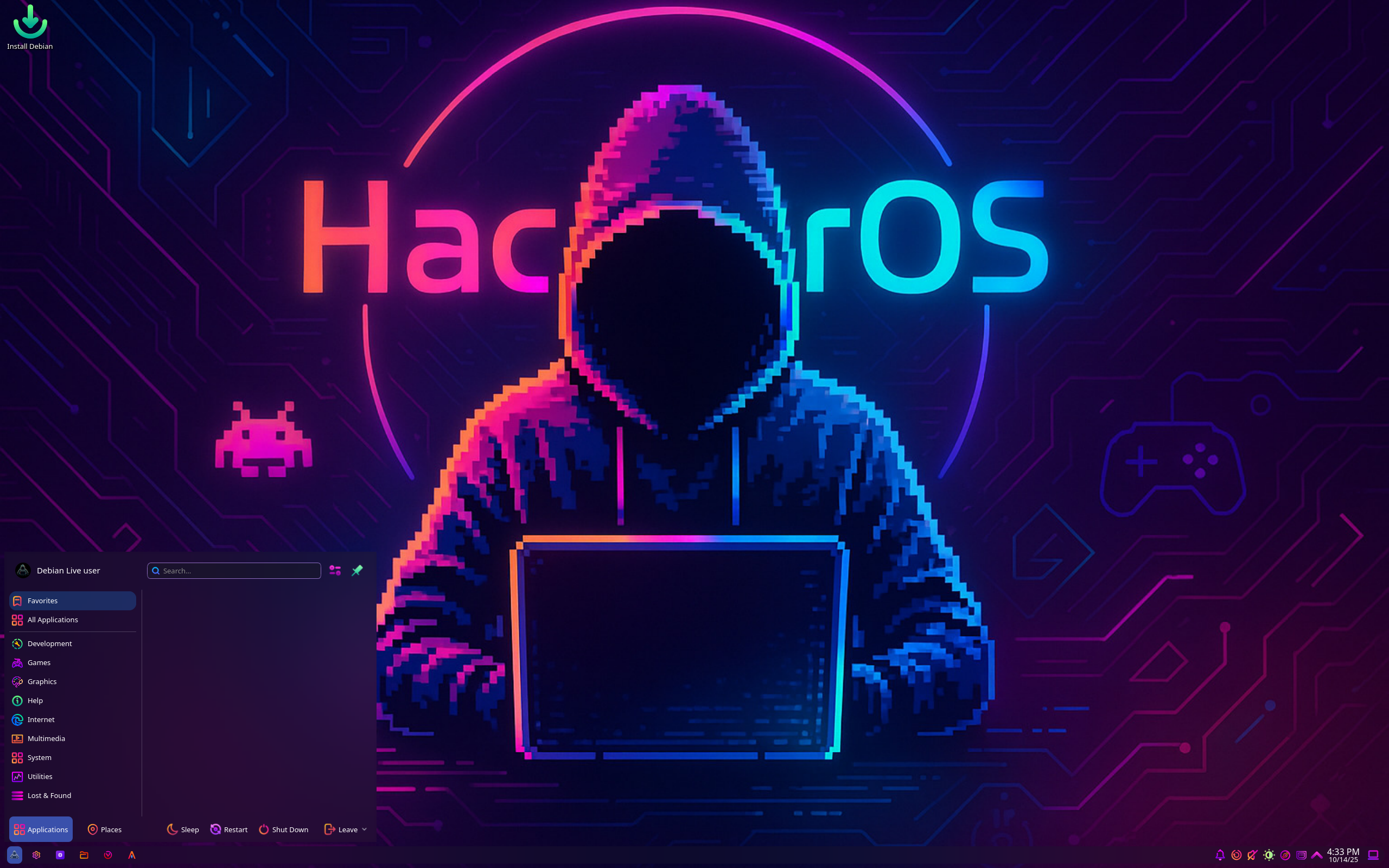
HackerOS Review
HackerOS 4.9: A Debian Testing Desktop for Gamers and Security Enthusiasts
HackerOS is a Polish-built, live Linux distribution based on Debian’s Testing branch, and it knows exactly who it is for: regular users, gamers, and cybersecurity enthusiasts. Rather than chasing the broadest possible audience, it tunes the familiar Debian ecosystem toward performance and protection.
The current release listed by DistroWatch is HackerOS 4.9, released on August 7, 2026. It is a free download, distributed as an ISO image of roughly 3 to 4 GB that boots as a live medium and installs through the Calamares graphical installer. KDE Plasma 6 is the default desktop, with GNOME and Xfce listed as alternatives.
The foundation is Debian Testing — the continuously developed branch of the distribution covered in our Debian review — but HackerOS pairs it with a semi-rolling release model rather than a fixed one. That means fresher packages than Debian’s stable branch delivers, without the full churn of a pure rolling release. Software is managed through APT in DEB format, with Flatpak and Snap support listed for newer or sandboxed applications.
HackerOS 4.9 at a Glance
| Release date | August 7, 2026 |
| Cost | Free |
| Based on | Debian (Testing) |
| Origin | Poland |
| Release model | Semi-rolling |
| Installation method | Calamares graphical installer |
| Default desktop | KDE Plasma (GNOME and Xfce also listed) |
| Default browser | Vivaldi |
| Package formats | DEB, Flatpak, and Snap |
| Package management | APT |
| Included office suite | LibreOffice |
| Supported architecture | x86_64 |
| Init system | systemd |
| Supported journaled file systems | Btrfs and ext4 |
| Typical ISO size | Approximately 3.0 GB to 4.0 GB |
| DistroWatch popularity rank | 39 (272 hits per day) |
| DistroWatch visitor rating | 5.5/10 from 2 reviews |
A Performance-Tuned Core: XanMod Kernel and NVIDIA Support
DistroWatch’s description of HackerOS highlights an optimised XanMod Linux kernel aimed at faster boot times and reduced resource usage, and the 4.9 package listing shows Linux kernel 7.1.6. For gamers, the more practical headline is out-of-the-box support for NVIDIA graphics cards — the 4.9 listing includes NVIDIA driver 550.163.01 — which removes one of the most common post-install chores on Debian-based systems. Gamers comparing options may also want to read our CachyOS review for a different take on a performance-minded desktop.
Security Tools, Preinstalled Rather Than Bolted On
On the security side, HackerOS ships a collection of cybersecurity tools — including enhanced firewalls and intrusion detection software — as part of the default system rather than leaving users to assemble them. DistroWatch files it under the Security category alongside Desktop, Gaming, and Live Medium. Readers who live in that world may also appreciate our Kali review, which covers the best-known Debian-based security distribution; HackerOS positions itself as the friendlier, everyday-desktop alternative rather than a specialist penetration-testing toolkit.
KDE Plasma by Default, With Room to Choose
The default experience is KDE Plasma 6 — the 4.9 listing shows plasma-desktop 6.7.2 — a modern, full-featured desktop that suits both the gaming and productivity sides of the distribution. Vivaldi is the listed default browser and LibreOffice is included, so the system is usable for documents, spreadsheets, and presentations immediately after installation. One limitation worth noting: the listing marks the distribution as English-only, so non-English speakers should check language support before committing.
Refinance Your Student Loan At Sofi
Installation and Everyday Practicality
As a live medium, HackerOS lets you boot the full system from the ISO and evaluate hardware compatibility — especially the NVIDIA support — before installing anything. Installation itself goes through Calamares, the same straightforward graphical installer used by another Debian-based option like MX Linux. Under the hood it is a conventional modern setup: systemd as the init system, with Btrfs and ext4 as the supported journaled file systems, on x86_64 hardware.
Who Should Try HackerOS?
- Gamers who want NVIDIA graphics support and a tuned kernel without post-install setup work.
- Cybersecurity enthusiasts who want firewall and intrusion-detection tooling preinstalled on a daily-driver desktop.
- Debian fans curious about the Testing branch in a friendlier, semi-rolling package.
- KDE Plasma users looking for a Debian-based home for the desktop.
- Distro hoppers who like evaluating a complete system from a live ISO before committing to an install.
Final Thoughts
HackerOS 4.9 is a niche distribution with a clear pitch: Debian Testing’s fresher packages, a performance-tuned XanMod kernel, working NVIDIA support, and security tools preinstalled, all wrapped in KDE Plasma and installed via Calamares. Its DistroWatch popularity rank of 39 and a 5.5/10 visitor rating from just two reviews mark it as early and little-known, so set expectations accordingly — but for gamers and security-curious users who want Debian without the wait for stable releases, it is a genuinely interesting option, and it costs nothing to try from the live ISO.
For release details, package versions, and the broader version history, see the HackerOS page at DistroWatch, which lists HackerOS 4.9 (released August 7, 2026) as the current release.