AV Linux Review
AV Linux MXe-25.2: A Debian and MX Linux Studio for Audio and Video Creators
Most distributions start with a desktop and add applications. AV Linux starts with a job to do. According to its DistroWatch listing, AV Linux is a versatile, Debian-based distribution featuring a large collection of audio and video production software. It is built for people who record, edit and mix — and it treats that work as the reason the system exists, not as something to bolt on afterwards.
The latest release tracked by DistroWatch is AV Linux MXe-25.2, released on 30 May 2026, following the AV Linux MXE-25 release announcement of 28 November 2025. It is a free download, listed as Active, and categorised by DistroWatch as a Desktop, Live Medium and Multimedia distribution. It currently sits at number 89 in DistroWatch’s popularity rankings with 160 hits per day, and visitors rate it 7.0 out of 10 from 38 reviews.
Its foundations will be familiar to readers of our MX Linux review: DistroWatch lists AV Linux as based on Debian (Stable) and MX Linux, originating in Canada, and built for x86_64 hardware. That is a deliberate pairing — a conservative, well-tested base underneath a very specialised set of creative tools.
At a Glance
| Latest Release | MXe-25.2 (30 May 2026) |
| Base | Debian (Stable), MX Linux |
| Origin | Canada |
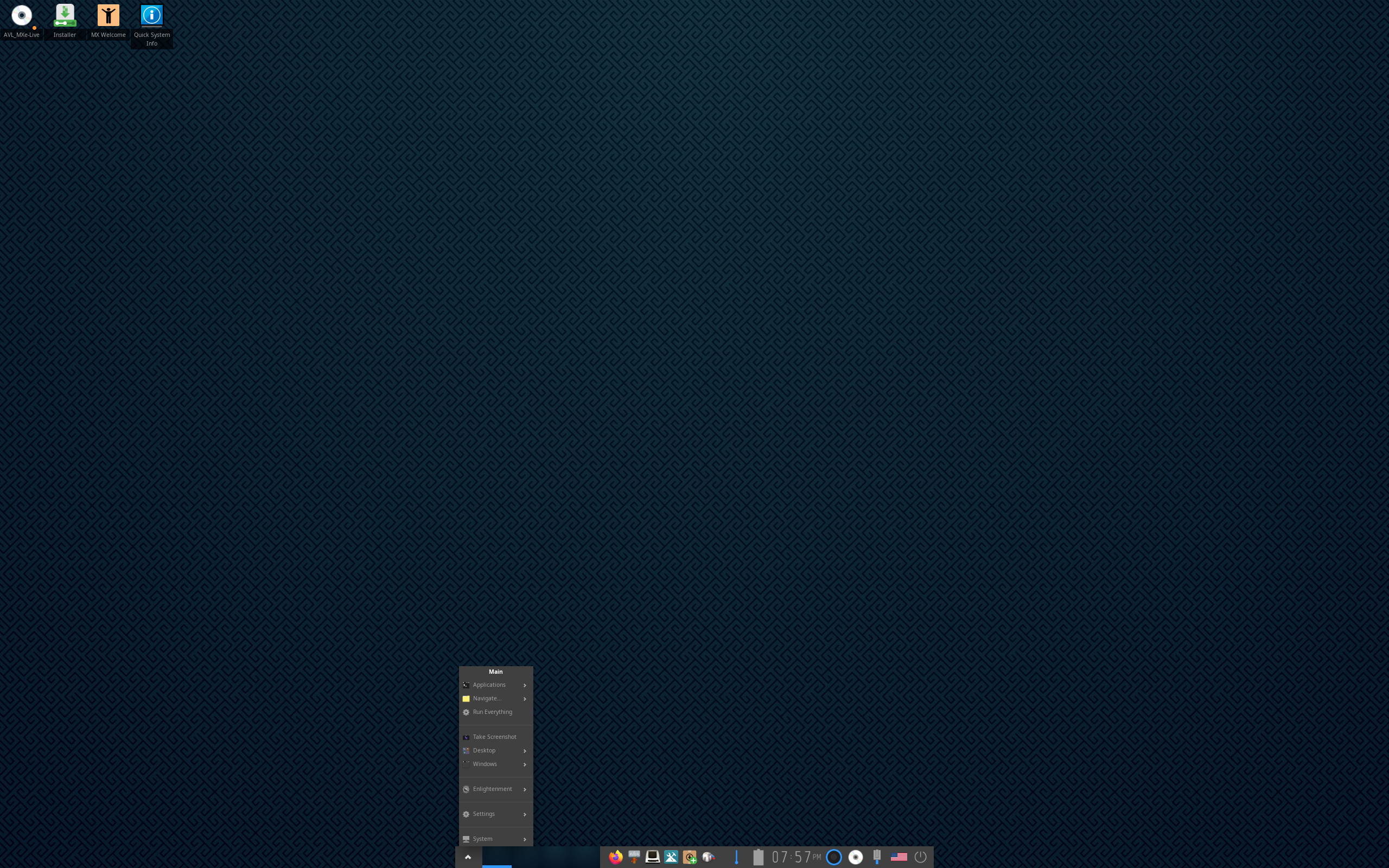
| Desktops | Enlightenment, Moksha (Enlightenment default) |
| Architectures | x86_64 |
| Installer | MX Installer (live ISO, approx. 4,300–4,400 MB) |
| Package Management | APT — deb and Flatpak formats |
| Release Model | Fixed |
| Init System | systemd |
| File Systems | Btrfs, ext4, JFS, ReiserFS, XFS |
| Default Browser | Firefox |
| Price | Free |
| DistroWatch Popularity | 89 (160 hits per day) |
| Visitor Rating | 7.0/10 from 38 reviews |
A Kernel Tuned for Low-Latency Audio
The detail that sets AV Linux apart is under the surface. DistroWatch notes that it includes a custom kernel with IRQ threading enabled for low-latency audio performance. For musicians and podcasters, latency is not a benchmark curiosity — it is the delay you hear between playing a note, singing a line or pressing a key and hearing it back through your monitors. A system tuned to keep that delay low makes live monitoring and multi-track recording far more practical, and it is something a general-purpose distribution rarely optimises for out of the box.
Free Credit Score Monitoring At Sofi
That focus sits on otherwise conventional mechanics. The MXe-25.2 release table lists APT for package management, in deb format with Flatpak also supported, a fixed release model, systemd as the init system, and support for the Btrfs, ext4, JFS, ReiserFS and XFS journaled file systems. Firefox is the default browser. In other words, the exotic part is the tuning and the tool selection — the day-to-day system underneath behaves like the Debian family it comes from, as our Debian review covers in detail.
Live First, Install When You Are Ready
DistroWatch explains that AV Linux can be run directly from a live DVD or a live USB storage device, though it can also be installed on a hard disk and used as a general-purpose operating system for everyday tasks. That live-first route matters for a creative system: you can boot it on your own hardware, check that your audio interface and peripherals are recognised, and only then install it through the MX Installer listed for MXe-25.2.
The ISO is substantial — DistroWatch lists an image size of roughly 4,300 to 4,400 MB for this release — which reflects the large collection of audio and video production software it carries. This is not a minimal base waiting for you to assemble a studio; the studio is the starting point. And because DistroWatch also notes its everyday use, the same installed system does not have to be a single-purpose box you only switch on to record.
Enlightenment and Moksha, Not the Usual Desktop Line-Up
AV Linux also makes an unusual desktop choice. DistroWatch lists Enlightenment and Moksha as its desktops, with Enlightenment as the default in the MXe-25.2 release table. That is a very different path from the GNOME, KDE Plasma and Cinnamon line-ups that dominate most Debian-based desktops — including our Linux Mint review, where Cinnamon is the headline. For a production system, a lighter, less demanding desktop leaves more of the machine’s resources for the audio and video work itself, and it gives AV Linux a look and feel that is distinctly its own.
Support follows the MX connection too: DistroWatch’s summary links AV Linux’s user forums to the MX Linux forum, and its home page and download mirrors to bandshed.net/avlinux. A small, specialised project with a real forum behind it is easier to troubleshoot than one with only a download page — particularly when your questions are about audio hardware rather than ordinary desktop use.
Who Should Try AV Linux?
- Musicians, podcasters and home-studio recorders — a large collection of audio production software and a custom kernel with IRQ threading enabled for low-latency performance, per DistroWatch.
- Video editors who want a ready-made toolkit — DistroWatch describes AV Linux as featuring video production software alongside its audio tools, in one installable live system.
- MX Linux and Debian users moving into creative work — if you like MX Linux’s take on the Debian base, AV Linux builds directly on that foundation.
- Anyone who wants to test before installing — run it live from DVD or USB first, check your hardware, then install with the MX Installer.
- Everyday users with a creative side — DistroWatch notes it can also be installed and used as a general-purpose operating system for everyday tasks.
Final Thoughts
AV Linux is a focused distribution with a clear audience, and that clarity is its appeal. A Debian Stable and MX Linux base, Enlightenment and Moksha desktops, APT package management, a fixed release model and a custom low-latency kernel add up to a system designed around making audio and video, not around being everything to everyone. A DistroWatch rank of 89 and a 7.0/10 visitor rating reflect a niche project with a loyal following. If your computer is also your studio, AV Linux MXe-25.2 is well worth booting from a live USB.
Source: DistroWatch’s AV Linux listing, covering the AV Linux MXe-25.2 release of 30 May 2026.