Aurora Review
Aurora 44.20261006: Silverblue Foundations, a KDE Plasma Workstation
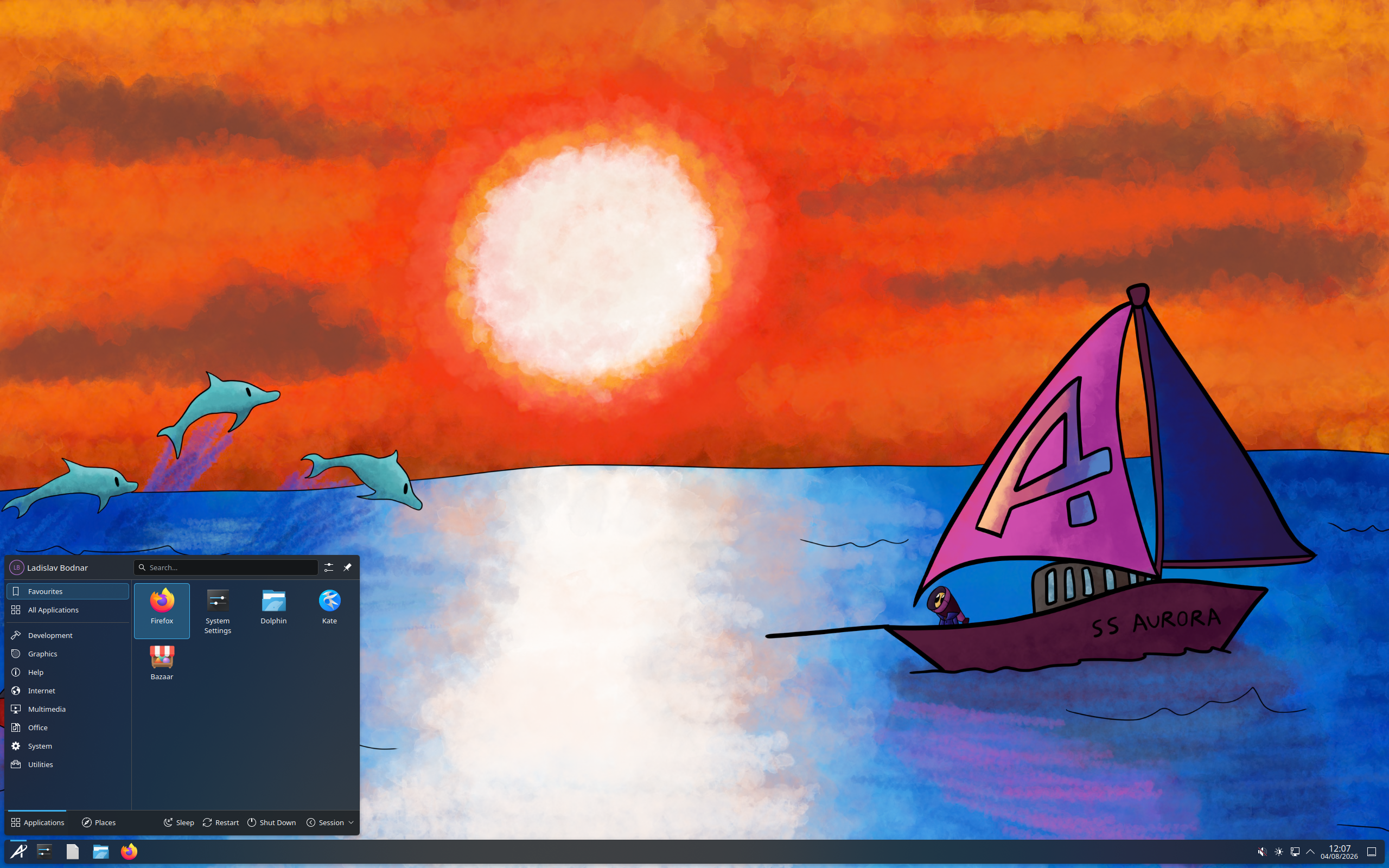
Some distributions ask you to build your desktop from spare parts. Aurora does the opposite: it hands you a finished workstation. According to its DistroWatch listing, Aurora is a Fedora Silverblue-based Linux distribution with the goal of being a general-purpose workstation, built around the KDE Plasma desktop. The newest release in DistroWatch’s feature table is Aurora 44.20261006, released on 6 October 2026, and the listing is marked Active.
The defining idea is immutability. Like Fedora Silverblue, Aurora’s root filesystem is immutable (read-only), which — in DistroWatch’s words — makes the system more stable, less prone to bugs, and easier to test and develop. Updates, upgrades and rollbacks to a previous image are available via the rpm-ostree utility, applications come as Flatpaks, and Toolbox containers handle command-line development environments. If you have read our Fedora review, you know the upstream this builds on; Aurora is what that foundation looks like when it is pre-assembled around Plasma instead of left for you to configure.
It is also finding an audience. DistroWatch ranks Aurora 84th in popularity with 163 hits per day, and its average visitor rating is a strong 8.9 out of 10 from 17 reviews — a notably warm reception for a workstation system that deliberately limits how much you can tinker with its core.
At a Glance
| Latest Release | Aurora 44.20261006 (6 October 2026) |
| OS Type | Linux |
| Base | Fedora (Fedora Silverblue-based, per DistroWatch) |
| Origin | Global |
| Desktop | KDE Plasma |
| Architectures | x86_64 |
| Installer | Graphical, per DistroWatch’s feature table |
| Package Manager | Flatpak for applications; rpm-ostree for system updates, upgrades and rollbacks, per DistroWatch |
| Package Formats | rpm, flatpak, per DistroWatch’s feature table |
| Release Model | Fixed |
| Init System | systemd |
| File Systems | Btrfs, ext4, XFS (journaled) |
| Category | Desktop, Immutable, Live Medium |
| Price | Free (ISO image size 5,900–6,000 MB; free ISO download) |
| DistroWatch Popularity | 84 (163 hits per day) |
| Visitor Rating | 8.9 / 10 from 17 reviews |
An Immutable Core You Are Not Meant to Poke
The read-only root filesystem is the whole point, and it changes daily habits. Per DistroWatch, the immutable base is what makes Aurora more stable and less prone to bugs, and rpm-ostree turns system management into image management: update to a new image, and if anything misbehaves, roll back to the previous one rather than debugging a half-updated system. That is a very different safety net from a traditional mutable install, where a bad update is yours to untangle package by package.
Aurora shares that atomic philosophy with our Bazzite review — another Fedora-based immutable system in this library — but the two point in opposite directions. Bazzite aims the same ideas at gaming; Aurora aims them at a general-purpose workstation, with KDE Plasma as the single desktop on offer rather than a choice of editions. Same safety model, very different day job.
KDE Plasma, Firefox and a Fixed Release Rhythm
There is no desktop menu to agonise over here: DistroWatch lists KDE Plasma as Aurora’s desktop across all three releases in its feature table — 44.20261006, 43.20260505 from 5 May 2026, and 42.20251111 from 11 November 2025 — with Firefox as the default browser throughout. The release model is Fixed, so Aurora follows a versioned cadence tied to its Fedora base rather than rolling continuously, and the ISO has actually slimmed down over that span, from 7,200–7,300 MB for the 42 release to 5,900–6,000 MB for the current one.
Plasma fans comparing vehicles will find an interesting contrast in our KDE neon review: neon chases the newest KDE software on a mutable base, while Aurora pairs Plasma with an image-based system where stability comes first. Underneath, the table lists systemd as the init system, journaled file systems of Btrfs, ext4 and XFS, multilingual support, and a graphical installer — conventional, reassuring choices wrapped around an unconventional core.
Flatpak for Apps, Toolbox for Everything Else
Because the base stays read-only, software arrives differently. DistroWatch’s feature table lists Aurora’s package formats as rpm and flatpak, with Flatpak named as the package management route for applications, and the listing specifically calls out Flatpak applications and Toolbox containers as part of the design. In practice that means your apps live independently of the system image — they can update, break or be removed without ever touching the OS itself — while Toolbox gives you a mutable container playground for compilers, libraries and command-line tools.
That separation is the honest trade of every atomic desktop: you give up casually installing system packages, and in return the machine underneath your work stops drifting. For a workstation — the role Aurora explicitly claims, per DistroWatch — that is usually the right bargain.
Who Should Try Aurora?
- Workstation users who value a system that heals itself — an immutable root filesystem with rpm-ostree rollbacks, per DistroWatch, aimed squarely at general-purpose workstation use.
- KDE Plasma fans who want it pre-assembled — Plasma is the desktop in every release DistroWatch lists, with Firefox as the default browser, no edition-hunting required.
- Fedora-curious users who prefer atomic updates — it is Fedora Silverblue-based, per DistroWatch; readers weighing the mutable original should start with our Fedora review and compare.
- Flatpak-first users and container-friendly developers — Flatpak applications and Toolbox containers are named features in the listing, per DistroWatch.
- Anyone burned by a bad update — rolling back to a previous image, per DistroWatch, beats an evening of package archaeology.
- Not inveterate system tinkerers — a read-only core is a feature until you want to modify it; if deep system customisation is your hobby, a traditional install will frustrate you less.
Final Thoughts
Aurora 44.20261006 is a confident, narrow bet: take Fedora Silverblue’s immutable, rpm-ostree-managed foundation, put KDE Plasma on it, and call the result a general-purpose workstation. DistroWatch lists it as Active, free, x86_64-only, and multilingual, with a fixed release model and a graphical installer keeping the on-ramp gentle. The 8.9 out of 10 visitor rating from 17 reviews suggests the bet is landing with the people who try it.
Try it as a live medium first, live with the Flatpak-and-Toolbox way of adding software for a few days, and see whether a system you cannot easily break feels liberating or limiting. If it feels liberating, Aurora may be the most boring workstation you ever love — and boring, in an operating system, is high praise.
Source: DistroWatch’s Aurora listing, covering the Aurora 44.20261006 release of 6 October 2026.