ALT Review
ALT Linux 11.2: Russia’s Independent System, Built on Sisyphus
Most distributions are built on another distribution. ALT Linux is not. According to its DistroWatch listing, ALT Linux is an independent distribution, forked from Mandrake, originating in Russia, and built on its own development infrastructure and repository called Sisyphus, which provides the base for all the different editions of ALT Linux.
The latest numbered release in DistroWatch’s feature table is ALT Linux 11.2, released on 15 July 2026. DistroWatch lists ALT Linux as Active and free, categorised as Data Rescue, Desktop, Education, Kubernetes, Live Medium, Raspberry Pi, Old Computers, Security and Server. That unusually wide category list matches the project’s own shape, in DistroWatch’s description: desktop distributions for home and office computers and for corporate servers, universal distributions with development tools and documentation, certified products, distributions specialised for educational institutions, and distributions for low-powered computers. Readers who know the other surviving branch of the Mandrake family should compare it with our Mageia review — Mageia also carries that heritage forward, but as a separate community fork with its own tools and release cycle.
ALT Linux was founded in 2001 by a merge of two large Russian free software projects, and by 2008 it had become, in DistroWatch’s words, a large organisation developing and deploying free software, writing documentation and technical literature, supporting users, and developing custom products. It ranks 121st in DistroWatch’s popularity rankings with 111 hits per day, and its average visitor rating is 8.7 out of 10 from 30 reviews — a strong score from the visitors who have rated it.
At a Glance
| Latest Release | ALT Linux 11.2 (15 July 2026) |
| OS Type | Linux |
| Base | Independent (forked from Mandrake) |
| Origin | Russia |
| Desktop | GNOME (default for 11.2); also AfterStep, Blackbox, Cinnamon, Enlightenment, FVWM, IceWM, KDE, labwc, LXDE, MATE, Openbox, LXQt, WMaker, Wayfire, Xfce |
| Architectures | aarch64, x86_64 for 11.2; aarch64, armhf, i586, mipsel, ppc64el, riscv64, x86_64 in the overall listing |
| Installer | Alterator |
| Package Manager | apt |
| Package Formats | flatpak, rpm |
| Release Model | Fixed for 11.2 (Rolling for Sisyphus, per DistroWatch’s feature table) |
| Init System | systemd for 11.2 |
| File Systems | ext4, XFS for 11.2 |
| Category | Data Rescue, Desktop, Education, Kubernetes, Live Medium, Raspberry Pi, Old Computers, Security, Server |
| Price | Free (ISO image size 7,900–8,000 MB for 11.2, per DistroWatch’s feature table) |
| DistroWatch Popularity | 121 (111 hits per day) |
| Visitor Rating | 8.7 / 10 from 30 reviews |
One Repository, Many Different Jobs
Sisyphus is the idea that holds ALT Linux together. DistroWatch says ALT Linux has its own development infrastructure and repository called Sisyphus, and that Sisyphus provides the base for all the different editions. In DistroWatch’s feature table, Sisyphus appears as its own column alongside the numbered releases, with a Rolling release model — while ALT Linux 11.2 itself is listed as Fixed. That split is the project’s rhythm: a continuously moving repository underneath, and numbered, fixed releases drawn from it for people who need a defined version.
The editions drawn from that base are deliberately varied. DistroWatch describes desktop distributions for home and office, distributions for corporate servers, universal distributions with a wide variety of development tools and documentation, certified products, distributions for educational institutions, and distributions for low-powered computers. Its category list underlines the same breadth, running from Desktop and Server to Education, Old Computers, Raspberry Pi, Security and Data Rescue. Few distributions in this series claim that many distinct jobs from a single repository.
RPM Packages, Managed With apt
The package story will surprise anyone who assumes RPM always means one particular set of tools. DistroWatch’s feature table lists ALT Linux 11.2’s package management as apt and its package formats as flatpak and rpm. So the packages are RPMs, the manager named by DistroWatch is apt, and Flatpak sits alongside as a second format — a combination that reflects ALT’s long independent history rather than a copy of either the Debian or the Fedora playbook.
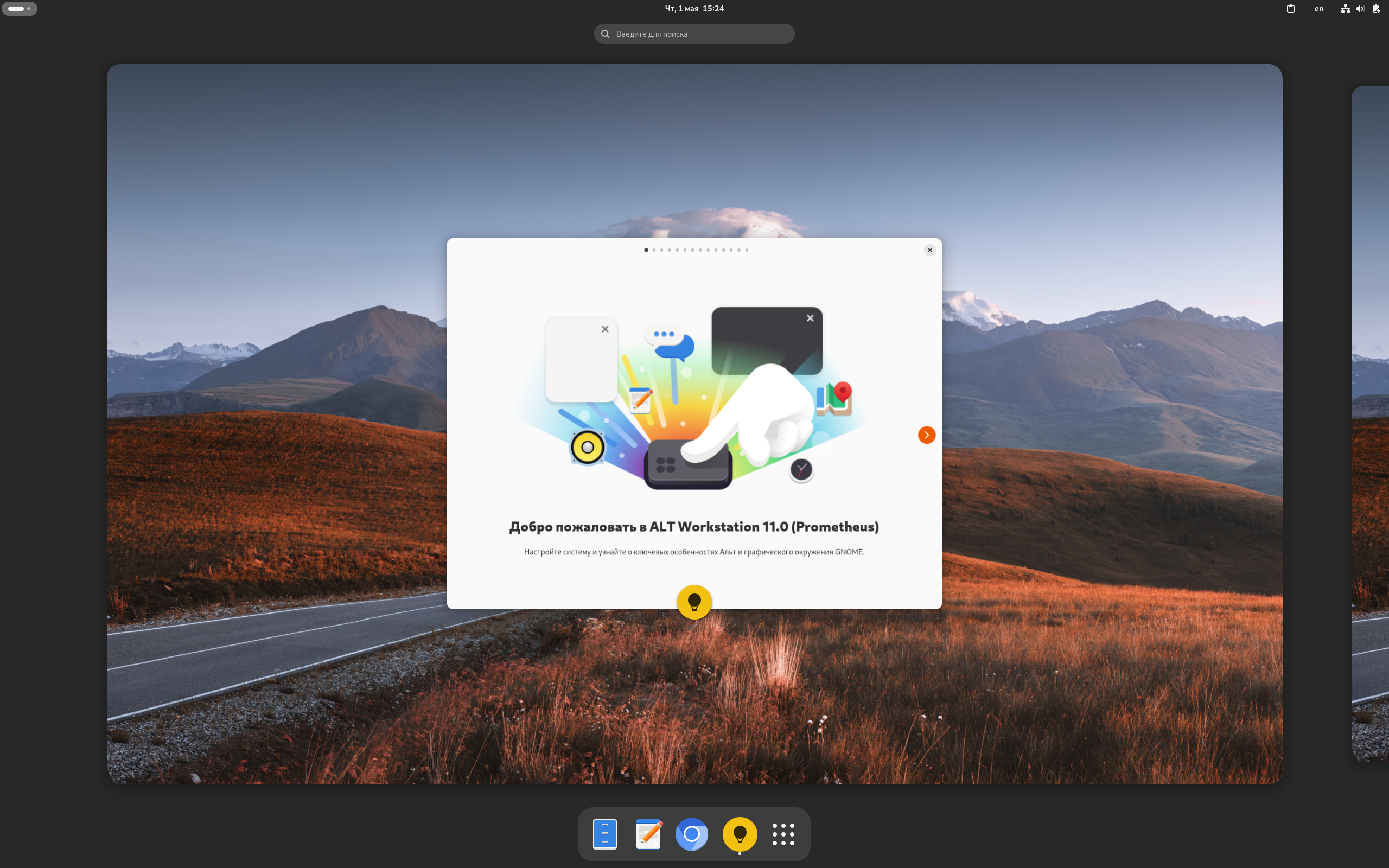
That Mandrake-era RPM heritage is also visible in our PCLinuxOS review, another independent system with roots in the same era. The two projects diverged long ago, though: PCLinuxOS took a rolling, single-architecture path, while ALT Linux keeps fixed numbered releases such as 11.2 alongside its rolling Sisyphus base, and lists many more architectures in its overall listing. Installation for 11.2 is by Alterator, per DistroWatch’s feature table, the default browser is Chromium, and LibreOffice is the office suite listed for 11.2. Multilingual support for 11.2 is listed as en, es, kk, pt, ru, tt and uk.
Sixteen Desktops, GNOME by Default for 11.2
Choice of desktop is not a side note here — it is one of the widest lists on DistroWatch. The listing names AfterStep, Blackbox, Cinnamon, Enlightenment, FVWM, GNOME, IceWM, KDE, labwc, LXDE, MATE, Openbox, LXQt, WMaker, Wayfire and Xfce. DistroWatch’s feature table names GNOME as the default desktop for 11.2, but the overall list covers modern desktops, lightweight window managers and several very old-school environments in the same project.
Try YouTube TV | Special Discount
That spread makes sense alongside the editions for low-powered and older computers that DistroWatch describes. A user who wants GNOME can have it as the 11.2 default; a user reviving older hardware has lighter options from the same family instead of switching distributions entirely. Readers weighing a more opinionated, single-desktop route could compare that approach with our Linux Mint review, where a small set of polished desktops is the appeal — ALT Linux goes the opposite way, offering breadth first.
Wide Architecture Support for a Fixed Release
DistroWatch’s overall listing for ALT Linux covers aarch64, armhf, i586, mipsel, ppc64el, riscv64 and x86_64 — seven architectures, including 32-bit and less common hardware that most desktop distributions have dropped. For 11.2 specifically, DistroWatch’s feature table lists aarch64 and x86_64, with systemd as the init software and ext4 and XFS as the journaled file systems.
Get An Easy Personal Loan At Sofi
The 11.2 download is large: 7,900–8,000 MB for the ISO, per DistroWatch. That size fits a universal, multi-purpose image rather than a minimal installer, and the project is categorised as a Live Medium as well as a Desktop and Server system, so it can be run live before installing with Alterator. Users who want a rolling system on a performance-tuned base instead could also see our CachyOS review — CachyOS rolls continuously, while ALT Linux 11.2 is a fixed release drawn from a rolling repository.
Who Should Try ALT?
- Users who want an independent system, not another derivative — DistroWatch lists ALT Linux as Independent (forked from Mandrake), built on its own Sisyphus infrastructure and repository.
- Schools, offices and server users who want editions made for the job — DistroWatch describes editions for educational institutions, home and office desktops, corporate servers and certified products.
- Desktop choosers — DistroWatch lists sixteen desktops and window managers, with GNOME as the default for 11.2.
- Users with older or unusual hardware — DistroWatch’s overall listing covers aarch64, armhf, i586, mipsel, ppc64el, riscv64 and x86_64, and describes distributions for low-powered computers.
- Not users who want a small download — DistroWatch lists an ISO image size of 7,900–8,000 MB for 11.2.
Final Thoughts
ALT Linux 11.2, released on 15 July 2026 per DistroWatch’s feature table, is a fixed, free release from one of Linux’s longest-running independent projects: founded in 2001, based in Russia, installed with Alterator, managed with apt over RPM and Flatpak packages, and defaulting to GNOME with fifteen other desktops and window managers listed. Underneath it, Sisyphus keeps rolling, supplying every edition from desktop to server to education.
If you are curious about a Linux lineage that did not pass through Debian, Ubuntu, Fedora or Arch — and especially if the Mandrake family interests you — ALT Linux is worth a live session. If you need a tiny installer or a distribution whose every edition is rolling, its DistroWatch listing makes clear that 11.2 is built to a different plan.
Source: DistroWatch’s ALT Linux listing, covering the ALT Linux 11.2 release of 15 July 2026.